Automotive
 Aviation
 Defense & Public Safety
 Manufacturing
 Logistics
 Public Transport
 Mobility
 Energy & Utilities
 Smart Farming
 Smart Buildings
 EV charging
 Healthcare
 Retail
 Media & entertainment

Imagine a fleet of trucks travelling across Europe, each one dodging traffic jams and predicting breakdowns without phoning home to a distant server. Or picture factory robots in Asia coordinating with American suppliers in real time, no cloud lag in sight. These scenarios are not science fiction.
They stem from edge computing in IoT, where data processing happens right at the device or nearby gateway, not in some far-off data center. This shift cuts delays from seconds to milliseconds, vital for industries where timing spells profit or peril. At Transatel, with decades pioneering global IoT connectivity, we have seen firsthand how the right technical protocols turn these visions into reliable reality.
Core Protocols Powering Edge Computing in IoT
Global IoT networks now handle billions of data points daily, overwhelming traditional cloud setups. Edge computing places intelligence right where the action happens, on sensors, vehicles, or factory robots. This reduces bandwidth usage significantly in high-volume scenarios and boosts response times to under 10ms, critical for applications like predictive maintenance.
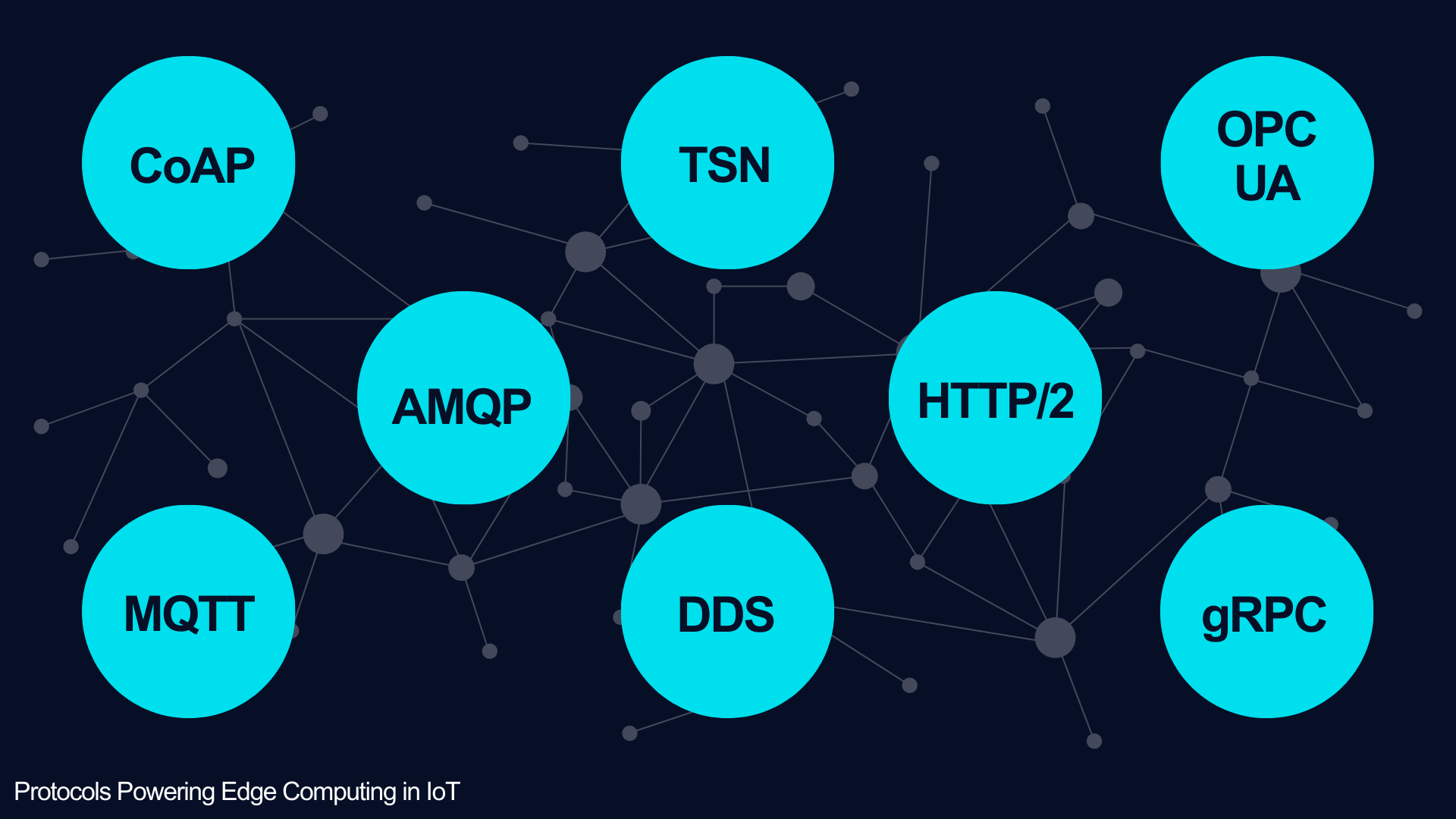
Start with MQTT, a lightweight publish-subscribe protocol born for low-bandwidth IoT. It lets devices “publish” data to topics while others “subscribe,” minimizing chatter. Telecom engineers favor it for its tiny overhead, ideal when 5G signals flicker in rural zones. Pair it with TLS for encryption, and CISOs sleep better knowing payloads stay secure end-to-end.
Then there’s CoAP, the UDP-based cousin of HTTP, tailored for constrained devices. Unlike TCP-heavy HTTP, CoAP handles packet loss gracefully, perfect for battery-powered sensors in remote oil fields. Product managers love its RESTful style, mirroring web APIs for easy integration. In our experience at Transatel, CoAP shines in hybrid LTE and 5G setups, where every byte counts toward global uptime.
For time-critical ops, enter TSN, or Time-Sensitive Networking, an IEEE extension to Ethernet. It ensures microsecond delivery, gluing sensors to actuators without jitter. Fleet managers deploying autonomous vehicles swear by it, as TSN ensures brake commands arrive precisely when needed, even amid video feeds.
Edge computing in IoT Use Cases Across Industries
Protocols alone gather dust without context. Take automotive fleets for example, where edge computing in IoT processes telematics data on vehicle. MQTT streams GPS and engine vitals to a gateway, triggering local alerts for tire wear. No cloud round-trip means drivers avoid breakdowns mid-haul. Transatel’s global (e)SIM, keeps these vehicles connected to LTE or 5G wherever roads lead. CEOs scaling from Europe to Asia report 40 percent latency drops, boosting delivery slots.
Shift to manufacturing. OPC UA, the interoperable industrial protocol, lets edge nodes query PLCs directly. Robots on a shop floor analyze vibration data via OPC UA, predicting failures before they halt lines. Zigbee meshes sensor swarms cost-effectively, feeding OPC UA hubs. IoT engineers at plants tell us this combo cuts downtime by 30 percent, with edge decisions handling 80 percent of routine tasks.
Logistics tells a unified story. Container trackers at ports use DDS, a data-centric protocol with quality-of-service guarantees. It pub-subs location and temp data across ships and trucks, enabling edge gateways to reroute loads dynamically. Fleet managers unify this with AMQP for queuing messages reliably over spotty maritime 4G. The result? Shippers glue automotive precision to industrial scale, slashing spoilage in cold chains from farm to store.
Public transport offers another thread. Bus fleets edge-process passenger counts via HTTP/2 multiplexing, optimizing routes live. gRPC accelerates API calls between vehicles and depots, its binary efficiency outpacing JSON over 5G. Telecom engineers integrate this with our platform for seamless handoffs across borders, turning city chaos into predictive flow.
Security Protocols in the Edge Spotlight
CISOs might flag edge as a vulnerability hotspot, with devices scattered like confetti. Enter zero-trust protocols like OAuth 2.0 with JWT tokens, verifying every edge request. No static keys; dynamic auth scales to millions of nodes. Combine with IPSec VPNs for tunnel-encrypted backhaul, standard in Transatel’s private 5G offerings. Real-world win: A logistics firm thwarted ransomware by edge-isolating compromised trackers via IP whitelisting.
Privacy amps up with differential privacy techniques in protocols like federated learning over gRPC. Devices train models locally, sharing only aggregates. This fits GDPR-tight Europe, where fleet data stays siloed yet actionable.
Key Challenges and Solution
Edge computing in IoT tempts with speed but trips on orchestration. Protocols clash in multi-vendor setups; MQTT might choke on DDS volumes. Solution? Our ‘single-pane-of-glass’ global connectivity platform abstracts this with a single API, auto-switching networks via global (e)SIM. Decades of connectivity experience mean we preload profiles for 200-plus countries, dodging roaming pitfalls.
Scalability bites too. Edge nodes multiply, demanding over-the-air updates via LwM2M, a CoAP-based device management protocol. It provisions securely, even offline-first. Product managers scaling to thousands report zero-touch bliss, with analytics dashboards spotting anomalies pre-failure.
Interoperability remains the key. With millions of (e)SIMs connected across the world, our decades of global connectivity experience enables us to guide your deployment, from protocol selection to borderless scaling.
Book a FREE 30-minute consultation with our Edge computing experts today. Share your use case, and get tailored protocol recommendations plus a custom connectivity strategy. Let’s make your edge unbreakable.