Automotive
 Aviation
 Defense & Public Safety
 Manufacturing
 Logistics
 Public Transport
 Mobility
 Energy & Utilities
 Smart Farming
 Smart Buildings
 EV charging
 Healthcare
 Retail
 Media & entertainment


Editorial Article, 7th July 2026 – Global IoT has entered a new phase. The challenge is no longer connecting a handful of devices in a single market, but operating large-scale deployments across countries, networks and regulatory environments while maintaining consistent performance, security and control.
As deployments grow, issues such as coverage, data routing, cybersecurity and compliance become business challenges, not just technical ones. At the same time, the market narrative can sometimes run ahead of reality. 5G will play an important role in IoT, especially for high-bandwidth, low-latency or private network use cases. But for many large-scale IoT deployments, 4G remains – and will continue to remain – the operational backbone for years.
In fact, as operators progressively retire 2G and 3G networks, many organizations are still focused on migrating existing deployments to 4G before even considering the transition to 5G. The question is not only which technology is available. It is whether it delivers the right coverage, hardware readiness, ecosystem maturity, and return on investment at scale.
Security is also moving to the center of the discussion. Every connected device expands the operational surface of a company. For critical use cases – vehicles, payment systems, healthcare devices, industrial equipment, energy infrastructure – secure connectivity is no longer a simple technical enabler. It is part of the service itself.
And sovereignty is becoming just as important. Infrastructure choices are increasingly shaped by regulation, data residency, cybersecurity rules and geopolitics. Where traffic is routed, where network components are located, and how data is protected are now strategic questions – not only network engineering decisions.
This is the context in which Transatel has been scaling. Originally founded in 2000, Transatel has built its position around one core idea: making cellular connectivity work globally, without forcing customers to rebuild their setup country by country.
Today, Transatel supports more than 10 million SIMs and eSIMs being deployed globally, covers 200+ countries and territories, works with 650+ corporate clients and strategic partners, and brings together 380 telecom experts in-house, in Paris.
But scale is not only about numbers. It is mostly about infrastructure. One of the key strengths behind Transatel’s model is its global core network and regional Points of Presence (PoPs). In simple terms, PoPs allow mobile data to exit closer to where devices are actually being used, instead of forcing traffic to travel back unnecessarily through a distant home network.
That matters for latency, application performance, resilience, and regulatory alignment. Transatel’s infrastructure includes regional PoPs across major geographies, with current and planned locations including Europe, North America, Latin America and Asia, as well as expansion areas such as India, Australia and South Africa.
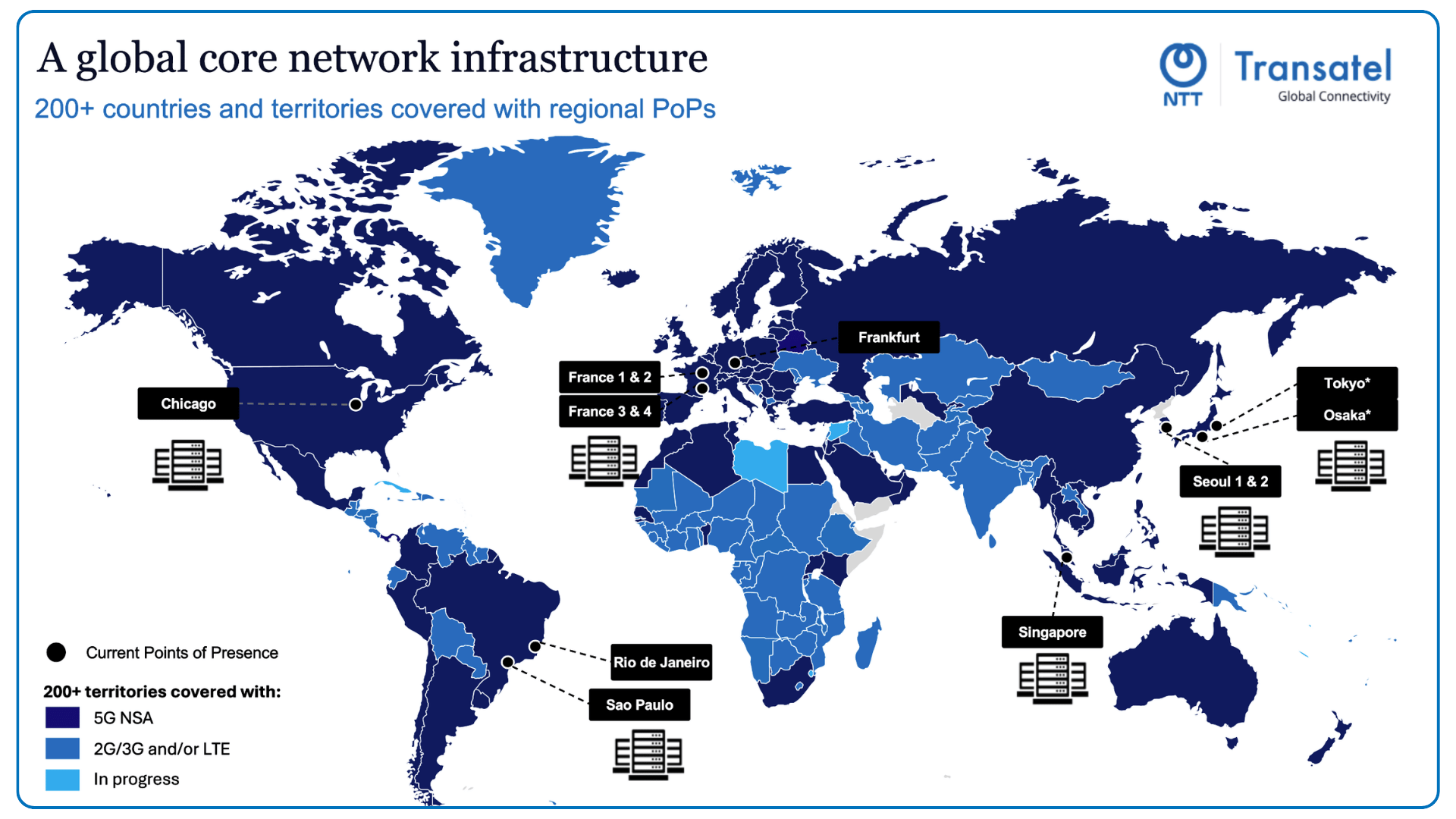
This architecture is particularly important for global customers. A connected asset in Asia, a vehicle in Europe, a payment terminal in Latin America or a field device in the US should not require a completely different connectivity model each time. The goal is to provide a consistent technical foundation – while adapting locally when performance, compliance or routing requirements demand it.
Transatel supports connectivity deployments for some of the world’s most demanding organizations, including BMW, Airbus, Air France-KLM, Worldline and Stellantis, while also collaborating with leading technology and security providers such as Palo Alto Networks, Zscaler, and Fortinet. Together, these relationships reflect the growing role of connectivity as a strategic component of digital transformation across industries.
That is also why Transatel’s role has expanded beyond SIM cards. Customers increasingly need a full connectivity layer: multi-network access, secure routing, private APNs, local regulation support, real-time diagnostics, usage controls, APIs, and advanced troubleshooting through a connectivity management platform.
The same logic applies to security. Instead of treating security as something added after connectivity, Transatel’s approach is by design closer to the network itself: private APN, encrypted routing, advanced SASE & Zero Trust options, AI-based anomaly detection, network redundancy, core infrastructure redundancy, and NOC/SOC operations.
This is becoming essential because global IoT deployments are rarely simple. Transatel supports use cases ranging from connected vehicles and aviation operations to retail, energy, public safety, smart buildings, manufacturing, logistics and healthcare. In automotive, for example, Transatel is involved in connecting 11 million BMW vehicles worldwide from 2025 to 2030 – a clear example of what “IoT at scale” actually means.
The same operating model applies across industries. A grounded aircraft can cost up to $950,000 per day, which makes real-time updates for aircraft, pilots and ground crews a business-critical need. Public networks can also become congested during major events, creating a need for seamless switching between private and public networks for mission-critical applications. This is where the value for customers becomes practical.
The promise is not “connectivity everywhere” as a slogan. The real value is being able to deploy once and scale globally with less operational friction. One contract. One SIM or eSIM setup. One platform. One support model. One technical foundation that can be extended across countries, devices and use cases.
For customers, that means fewer country-by-country adaptations, less internal complexity, faster time-to-market, stronger reliability, and better control over performance and security. And the next phase is already taking shape.
eSIM and eUICC are changing how companies manage connectivity over the lifetime of a device. The GSMA SGP.32 standard is designed specifically for IoT use cases, enabling remote eSIM provisioning without local user interaction – a major step for devices deployed globally and at scale.
Non-terrestrial networks will also extend the reach of IoT. With 3GPP Release 17 enabling satellite narrowband IoT on standard modules, the future points toward hybrid cellular and satellite connectivity, where one SIM can switch between terrestrial and satellite networks depending on availability.
AI is no longer a buzzword or a future promise for IoT. It is already reshaping the way connectivity is managed. At Transatel, customers can use AI to interact directly with their SIM fleets using natural language – whether to diagnose a device, investigate an anomaly or analyze usage across thousands of connections. As IoT deployments continue to grow in scale and complexity, AI will increasingly help teams reduce operational effort, accelerate troubleshooting, and make faster, data-driven decisions in real time.
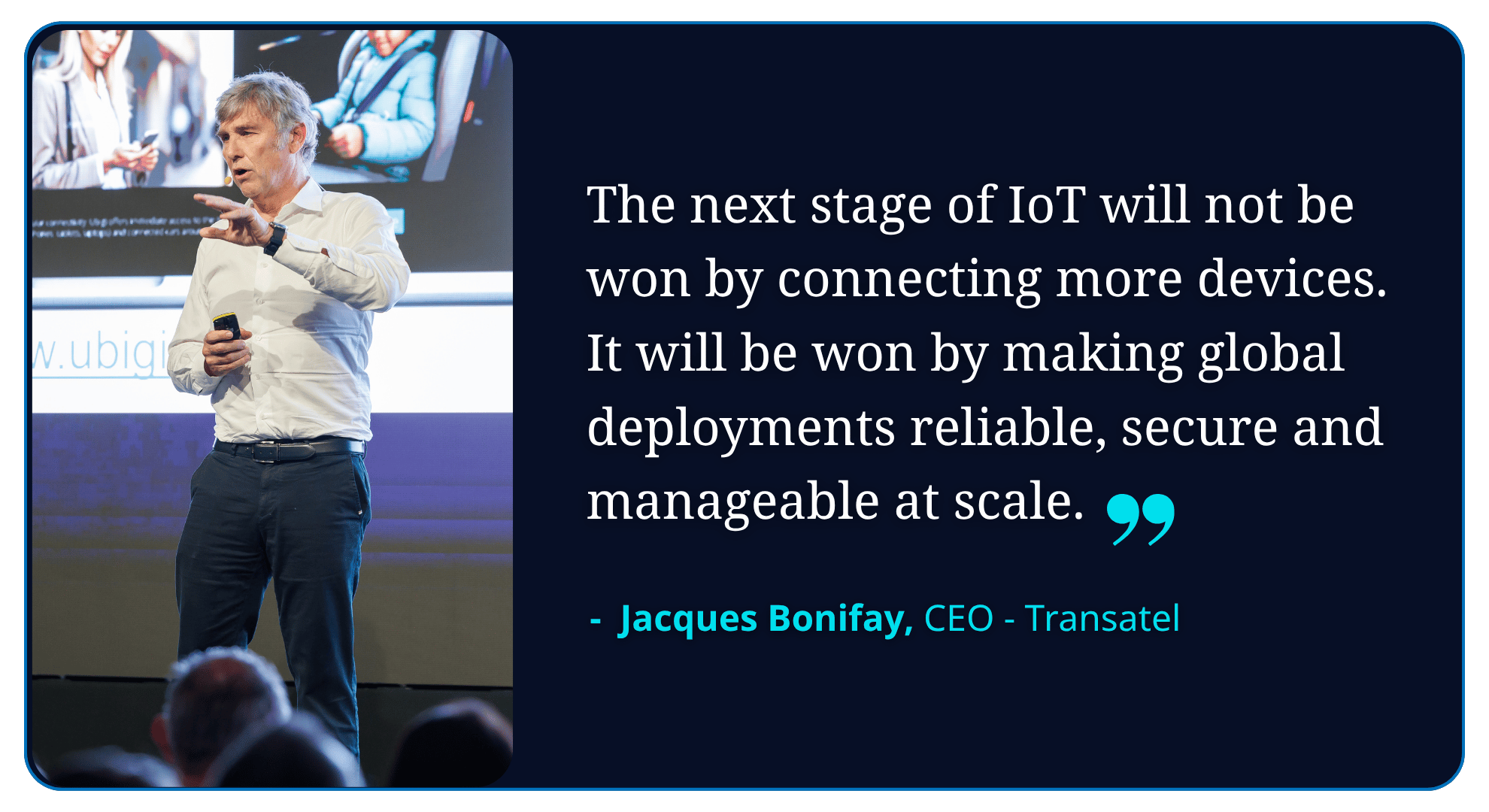
The conclusion is simple: IoT is no longer only about connecting devices. It is about operating connected services reliably, securely, and globally.
Transatel’s role is to absorb that complexity – through infrastructure, operational expertise, security, local presence, and global reach – so you can focus on scaling your own services with confidence.