Automotive
 Aviation
 Defense & Public Safety
 Manufacturing
 Logistics
 Public Transport
 Mobility
 Energy & Utilities
 Smart Farming
 Smart Buildings
 EV charging
 Healthcare
 Retail
 Media & entertainment

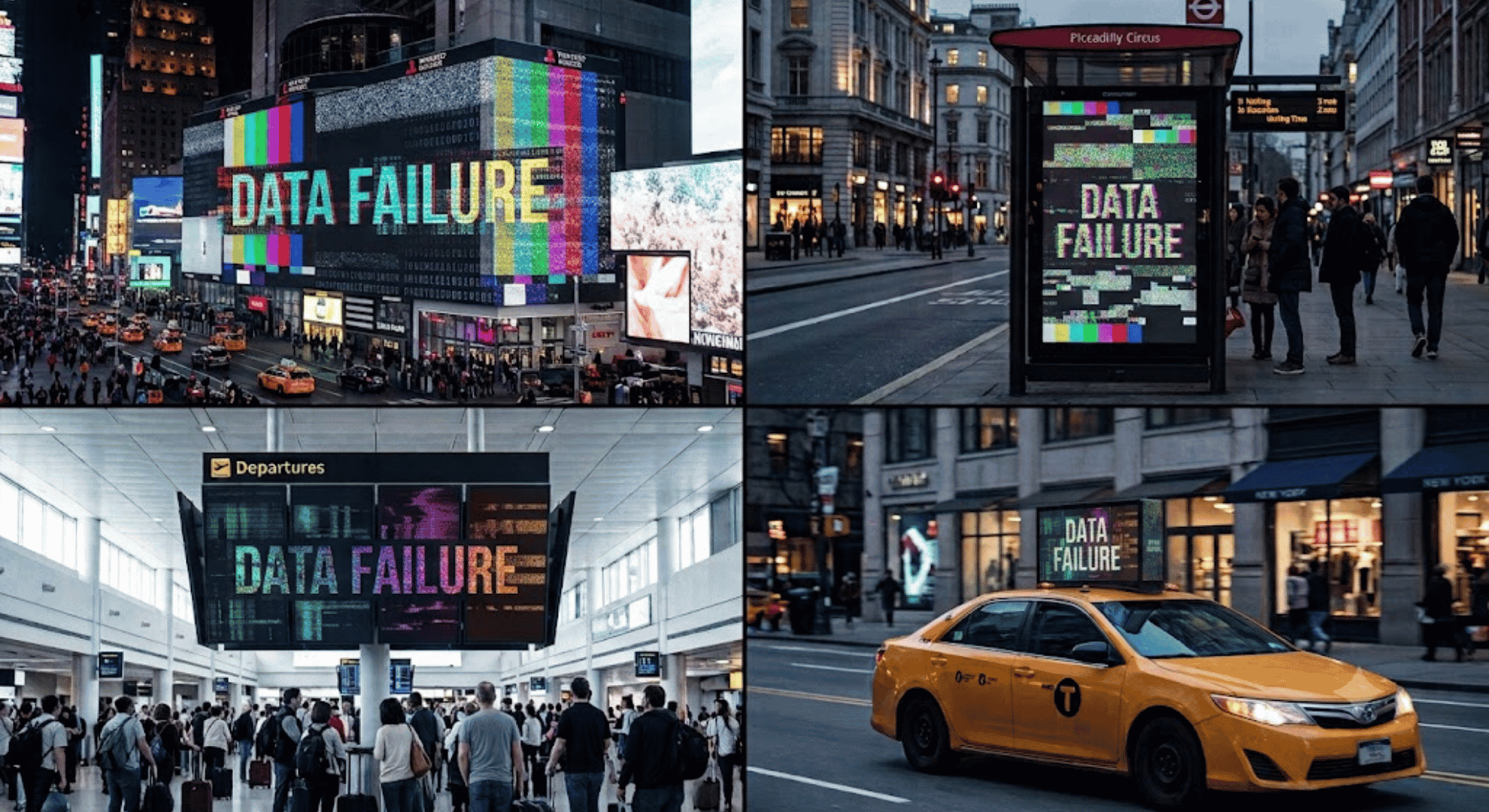
Imagine a fleet of 200 digital screens spread across shopping malls in five countries, all running the same campaign for a major retailer. One morning, a third of them go dark and the DOOH operators fail to notice it.
Now picture an airport operator managing flight-information screens across four terminals until they freeze out of the blue at the peak hour. These stories all point to the same blind spot: connectivity failures.
Most Digital Out-of-Home (DOOH) strategies are built around the screen: resolution, brightness, content management software, design. But there is still left the one thing that keeps all of it alive, the network connecting the screen to the rest of the world.
What screen downtime really costs
A fleet of connected screens is only as valuable as its uptime. As deployments scale from a handful of screens to hundreds, the limits of ad hoc connectivity show up fast:
- Fragmented contracts per region or country.
- No visibility without access to a centralized platform.
- Manual troubleshooting with physical maintenance.
For a DOOH network operator, the costs add up in the blink of an eye with:
- Breached SLAs when screens go dark.
- Reputational damage with advertisers.
- Operational overhead from dispatching technicians.
- Lost revenue with unusable displays.
However, this can be overcome through a cellular connectivity solution, enabling to turns reactive firefighting into proactive fleet management thanks to:
- Predictive alerts notify operators the moment a screen loses signal, often before anyone on-site notices.
- Centralized visibility shows the real-time status of every screen, in every market, from a single dashboard.
- Remote configuration and diagnostics resolve most issues without a site visit.
LPWAN vs Cellular : Not all digital signage connectivity is equal
Nonetheless, in connectivity we can distinguish two main types of networks: cellular and LPWAN, and each don’t have the same capacities.
LPWAN, acronym for low-power wide-area technologies, like LoRaWAN, are built for small, infrequent payloads, such as a sensor reading every few minutes, sent over long range on minimal power.
However, DOOH screens need the opposite: continuous content delivery, frequent status reporting, and remote management. Cellular connectivity is built for that load; LPWAN simply isn’t designed to carry it.
Why cellular IoT connectivity fits best
However, cellular connectivity doesn’t mean equal performance. Many screens still run on aging 2G or 3G connections, which operators are progressively shutting down, market by market, turning a working screen into a blank one overnight.
Thus, screen operators need to get ahead and move to 4G, 5G, and even the futurist 5G Stand Alone. This transition is supported by the market, with the SGP.32 eSIM standard changing how fleets get managed day to day, enabling remote provisioning without a technician swapping a physical SIM.
This new standard is providing enough bandwidth for rich content, broad existing coverage, and the ability to scale a fleet without a cabling crew at every new site.
5G connectivity also adds:
- Higher bandwidth for richer and more dense content.
- Lower latency, increasingly relevant as signage shifts from static playlists to real-time, data-driven content.
- Capacity for dense deployments, useful in venues where many screens and devices operate close together.
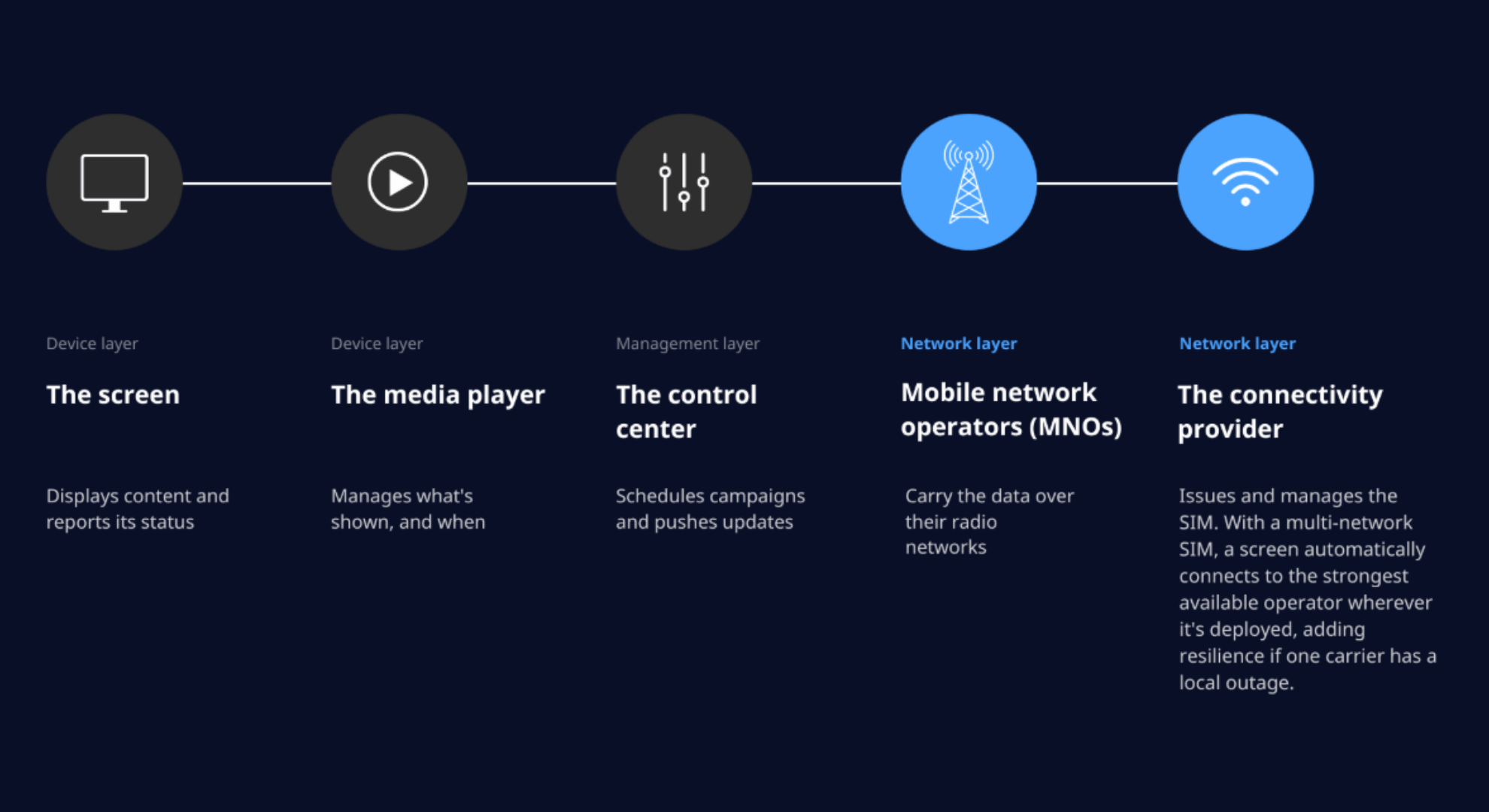
How the IoT connectivity chain works
For a connected screen to work, the chain of actors is key. From the network operator to the content manager, whether to monitor the screen or ensure its uptime, flawless interactions between all these actors are mandatory to ensure a seamless management of the fleet.
Where connected screens are already proving the model
Across industries, connectivity is already enabling large-scale screen networks to operate efficiently and at scale, at for example:
- High-traffic venues such as stadiums and city centers, where large numbers of screens need to stay synchronized during peak footfall.
- Airports and train stations, where wayfinding and departure information must stay accurate and update rapidly across terminals with different local network conditions.
What’s next for the DOOH eco-system?
What we can expect for the future of DOOH is faster fleet deployment, more data-driven content, and new display formats; operations highly demanding for the network behind them.
Operators who treat connectivity as core infrastructure today will be the ones able to adopt what comes next without rebuilding from scratch. If you’re scaling a fleet of connected screens and want one reliable connectivity layer behind it, Transatel’s global cellular IoT connectivity can help.
Book a FREE consultation with our team of global connectivity experts to future-proof your DOOH eco-system.