Automotive
 Aviation
 Defense & Public Safety
 Manufacturing
 Logistics
 Public Transport
 Mobility
 Energy & Utilities
 Smart Farming
 Smart Buildings
 EV charging
 Healthcare
 Retail
 Media & entertainment

Imagine a taco-truck in Los-Angeles, handling online orders during peak hours without dropped connections, a family in rural Australia streaming 4K movies without buffering, or a construction site in Texas coordinating drones in real time. Fixed wireless access (FWA) makes these scenarios possible by delivering high-speed internet straight from cellular towers to a rooftop antenna, no digging or cables required.
This technology skips the hassle of traditional broadband setups, offering a plug-and-play alternative that works almost anywhere with cellular coverage. As global networks upgrade to 5G, fixed wireless access (FWA) stands out for its speed and simplicity, drawing interest from households and enterprises alike.
Definition of Fixed wireless access (FWA)

Fixed wireless access provides internet to stationary points through point-to-point or point-to-multipoint radio links. Unlike mobile data on your phone, it targets buildings or premises with rooftop antennas pointed at a base station, often 1-10km away. This setup creates a dedicated wireless “pipe” for data, much like a virtual fibre line in the air.
Unlike mobile data plans, it uses fixed antennas for stability, hitting speeds from 50Mbps in basic setups to over 1Gbps on premium 5G links. Providers mount a small dish or antenna on your roof, connect it to a router inside, and activate service often within days.
This approach relies on licensed spectrum from cellular carriers, ensuring priority access overcrowded public networks.
Evolution of Fixed wireless access technology
Fixed wireless access traces back to early WiMAX trials in the 2000s, but LTE in 2010 brought viability with better spectrum efficiency. 5G non-standalone (NSA) in 2019 accelerated adoption, followed by standalone (SA) cores for ultra-reliable service.
Recent advances like massive MIMO multiply capacity per tower, serving hundreds of fixed users without congestion. Open RAN integrations lower costs, letting more providers enter markets ignored by fibre.
By 2030, expect hybrid satellite-cellular handoffs for true global reach, blending tower signals with low-earth orbit beams.
How does FWA work?
The process starts with line-of-sight between your antenna and the tower, though modern systems manage minor obstacles like trees with beamforming tech. Your outdoor unit captures the signal, converts it to Ethernet, and feeds it to an indoor modem for local Wi-Fi.
Key components include the customer premises equipment (CPE), a compact device with built-in amplifiers for longer ranges up to 10km. Backhaul links the tower to the core network via fibre or microwave, keeping latency low at 15-30ms, competitive with cable internet.
Service tiers scale by aggregating multiple carriers’ bands, boosting throughput during peak times without slowdowns.
Fixed wireless access vs broadband options
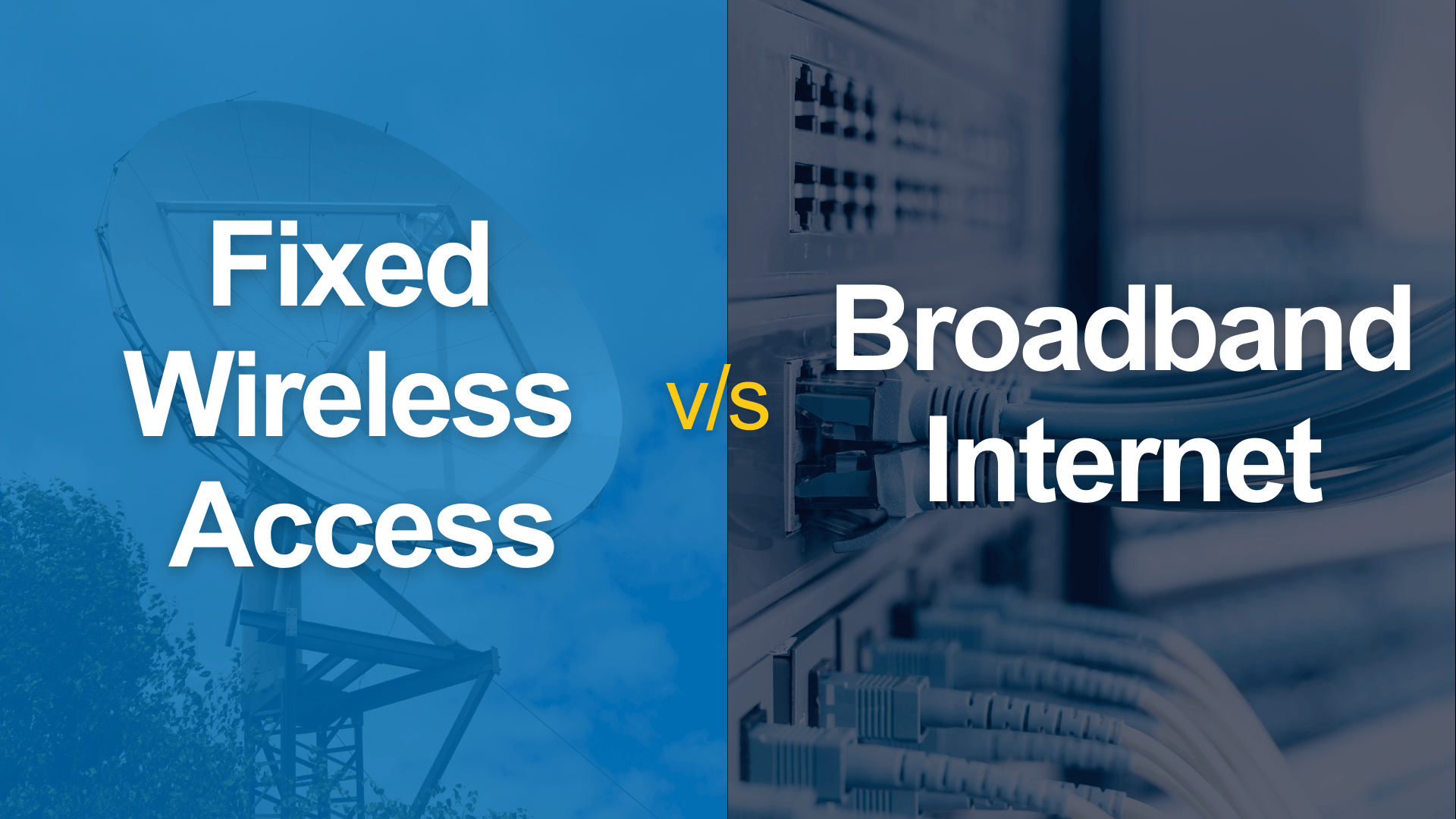
- Versus fibre: Fixed wireless deploys faster and cheaper but lags in unlimited bandwidth.
- Cable rivals speed short-term but choke on shared lines.
- DSL suits basics only, with 20Mbps caps.
- Satellite offers reach but 600ms latency kills real-time use.
| Option | Deployment time | Max Speed | Cost/Mo (US Avg.) | Best for |
| Fixed Wireless | 1-7 days | 1Gbps | $50 | Rural/Business |
| Fibre | 3 -12 months | 2Gbps+ | $70 | Urban High-End |
| Cable | 1-4 weeks | 1Gbps | $60 | Suburbs |
| DSL | 1 week | 100Mbps | $40 | Basic Home |
| Satellite | 1-2 weeks | 150Mbps | $100 | Remote Extremes |
Real-world FWA use cases across industries
- Retail chains in LATAM deploy it for connected point-of-sale systems in pop-up stores, new stores, activating connectivity overnight to process payments seamlessly. One network expanded to 200 locations in six months, avoiding months-long cable permits.
- Manufacturing plants in South Korea connect assembly robots via fixed wireless access, achieving sub-10ms latency for real-time adjustments. During a factory relocation, downtime dropped to hours, saving thousands in lost production.
- Logistics firms in Canada equip remote warehouses with it for inventory tracking, integrating dashcams and telematics over unified 5G pipes. Energy providers pipe SCADA data from offshore rigs, ensuring compliance without vulnerable leased circuits.
- Healthcare clinics in rural Mexico stream telehealth visits, with bandwidth for patient records syncing instantly.
Benefits that set FWA apart
Quick deployment tops the list: no trenching means service in days, ideal for events or pop-up sites. Scalability shines as providers remote-upgrade antennas for 5G without visits.
Costs stay 20-40% below fibre, with no build-out fees. Environmentally, it reduces urban digging, cutting carbon from construction by up to 70%. Reliability matches wired options in most climates, with failover to secondary towers.
For businesses, SLAs guarantee 99.99% uptime, backed by cellular redundancy.
Challenges and practical solutions
Obstacles like buildings can weaken signals, but elevated mounts or repeaters extend range. Capacity limits in dense areas prompt smart throttling, prioritising fixed users. Regulations vary by country, but licensed spectrum ensures interference-free operation. Users mitigate congestion by choosing providers with diverse tower partnerships. Future mmWave bands will unlock urban densities.
Multi-network cellular connectivity boosts redundancy in Fixed Wireless Access (FWA) solutions by linking to multiple carriers simultaneously. This setup ensures seamless operation even if one network faces issues. Benefits include:
1. Key Reliability Gains
- Devices automatically switch to the strongest available signal from different providers, minimizing downtime during outages or congestion.
- Enterprises avoid single-carrier dependency, which supports business continuity for critical operations like remote offices or retail sites.
- Uptime often exceeds 99.99% with automatic failover mechanisms.
2. Cost and Deployment Advantages
- Multi-network FWA cuts deployment time since no new wiring is needed, and it scales easily by adding capacity across carriers.
- It lowers long-term costs through optimized data routing to the best network, avoiding expensive roaming fees.
- Businesses gain flexibility without lock-in to one operator.
3. Performance Enhancements
- Users experience consistent low latency and high speeds by load-balancing traffic over multiple networks.
- This redundancy handles peak demands or regional disruptions better than single-network FWA, ideal for bandwidth-heavy applications.
- Coverage gaps shrink due to overlapping carrier footprints.
Connectivity expertise in global FWA deployments
With seamless coverage across 200+ countries & territories delivering consistent performance, from LTE-M backups to 5G frontiers, Transatel’s Flexible wireless access connectivity solution helps shape reliable FWA deployments.
Book a meeting with our experts to assess your site’s connectivity needs, benchmark speeds, and plan a seamless FWA rollout. Let’s get your business connected.