Automotive
 Aviation
 Defense & Public Safety
 Manufacturing
 Logistics
 Public Transport
 Mobility
 Energy & Utilities
 Smart Farming
 Smart Buildings
 EV charging
 Healthcare
 Retail
 Media & entertainment

From New York to Shanghai, cities are under pressure to do more with less. Energy demand is rising, transport systems are becoming more connected, EV charging networks are expanding, and public authorities are being asked to deliver cleaner, more resilient services without compromising reliability or security.
That is where cloud connectivity for smart cities comes in. At its simplest, it means the secure, reliable data connection that allows city assets, sensors, utilities, and operational systems to send information to cloud platforms and receive commands back in real time.
It sounds straightforward, but it is the difference between a city that merely collects data and a city that can actually act on it.
What cloud connectivity for smart cities really means
Cloud connectivity for smart cities is the communications layer that links physical urban infrastructure to cloud-based applications. It connects smart meters, substations, EV chargers, traffic systems, environmental sensors, video devices, and other connected assets to the platforms that analyse, automate, and coordinate them.
In practice, this means the network must do far more than move data from point A to point B. It must support low latency, consistent uptime, strong security, and enough bandwidth to handle high volumes of telemetry. For city operators, that makes connectivity a core part of digital infrastructure, not an IT afterthought.
Why the cloud alone is not enough
Many smart city strategies begin with the cloud, but the cloud cannot deliver value if the network feeding it is unreliable. A beautifully designed dashboard is useless if it receives stale, incomplete, or delayed data.
This is particularly important for energy systems. Smart grids depend on continuous communication between devices and control platforms. If a fault signal arrives too late, or a switching command is delayed by congestion, the consequences can escalate quickly. That is why cloud connectivity for smart cities has to be engineered with the same seriousness as the assets it supports.
For this reason, cellular IoT connectivity has become a strong fit for critical urban deployments. It offers wide coverage, mobility, mature security controls, and the ability to scale across neighbourhoods, districts, and even multiple countries with a common operating model.
Why cellular connectivity is a better fit
For many smart city use cases, cellular networks provide a more dependable foundation than short-range or shared connectivity options. They are designed for broad coverage, managed service quality, and secure device authentication at scale.
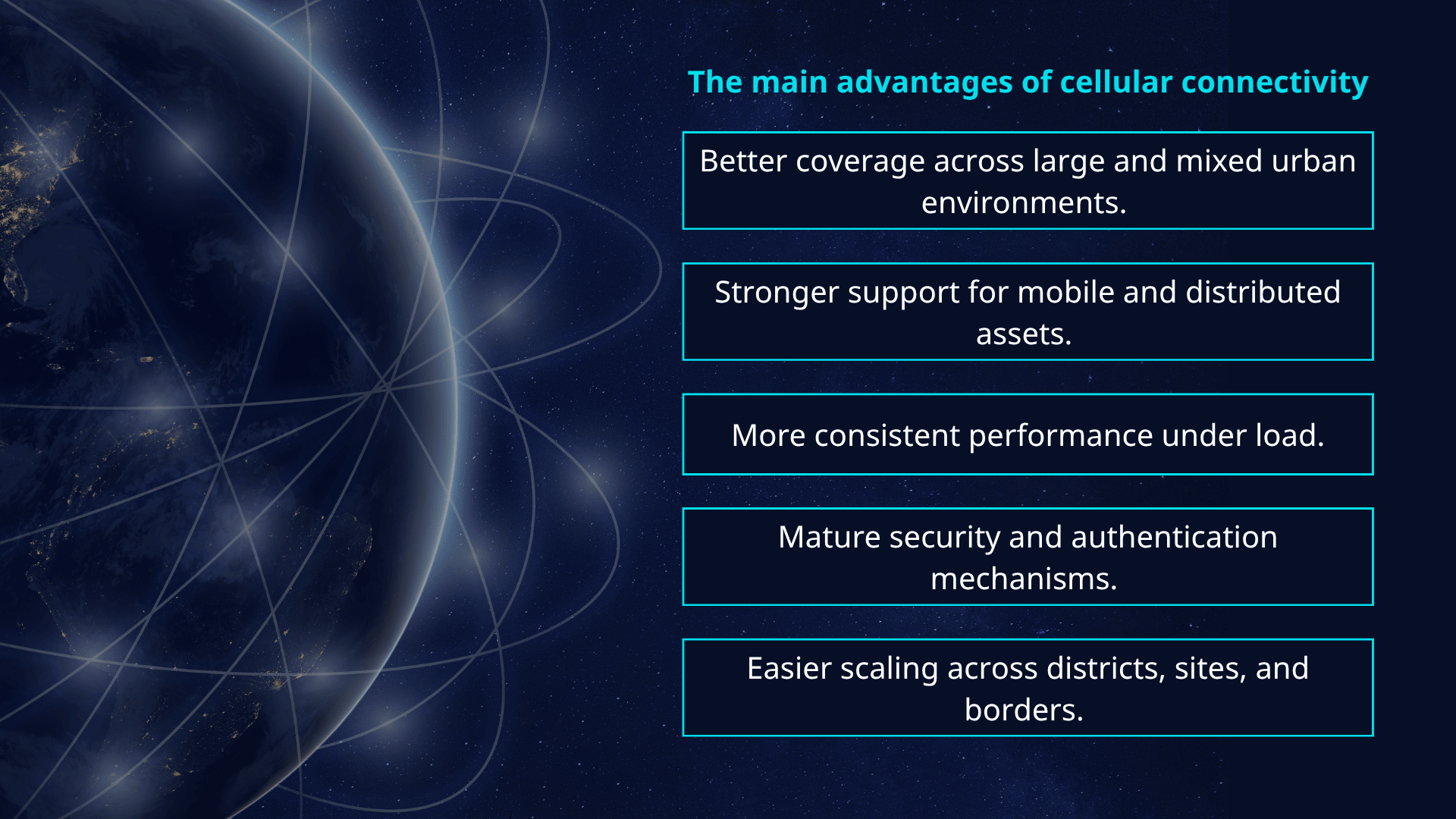
The main advantages are straightforward:
- Better coverage across large and mixed urban environments.
- Stronger support for mobile and distributed assets.
- More consistent performance under load.
- Mature security and authentication mechanisms.
- Easier scaling across districts, sites, and borders.
For municipal teams, this matters because city infrastructure is rarely uniform. A deployment may span roads, utility cabinets, rooftops, underground plant rooms, parking structures, and public spaces. Connectivity has to work across all of them, not just in the easiest locations.
Where 5G changes the equation
If 4G provides the dependable baseline, 5G introduces the tools needed for more advanced smart city operations. Its value is not just speed. The real shift is in how it supports isolation, prioritisation, and edge-aware use cases.
5G network slicing
Network slicing allows one physical network to be divided into multiple virtual networks, each with its own performance and security characteristics. For a smart city, that means energy control traffic does not have to compete with consumer traffic or lower-priority data.
This is especially useful for critical urban systems. A city can allocate a dedicated slice for grid control, another for public safety applications, and another for general IoT traffic. The result is better traffic separation, greater predictability, and improved resilience.
Multi-access edge computing
MEC moves processing closer to the source of the data. Instead of sending every packet to a distant cloud region before making a decision, cities can process time-sensitive information at the edge and only forward what needs deeper analysis.
That helps reduce latency, conserve bandwidth, and improve response times for use cases such as grid fault detection, traffic optimisation, and local incident response.
Private 5G
Private 5G gives organisations more control over coverage, traffic handling, and security. For municipalities and utilities managing critical infrastructure, that control can be highly valuable. It supports tighter policy enforcement, better segmentation, and more predictable service levels in environments where public networks may not be sufficient.
How city leaders should think about the architecture
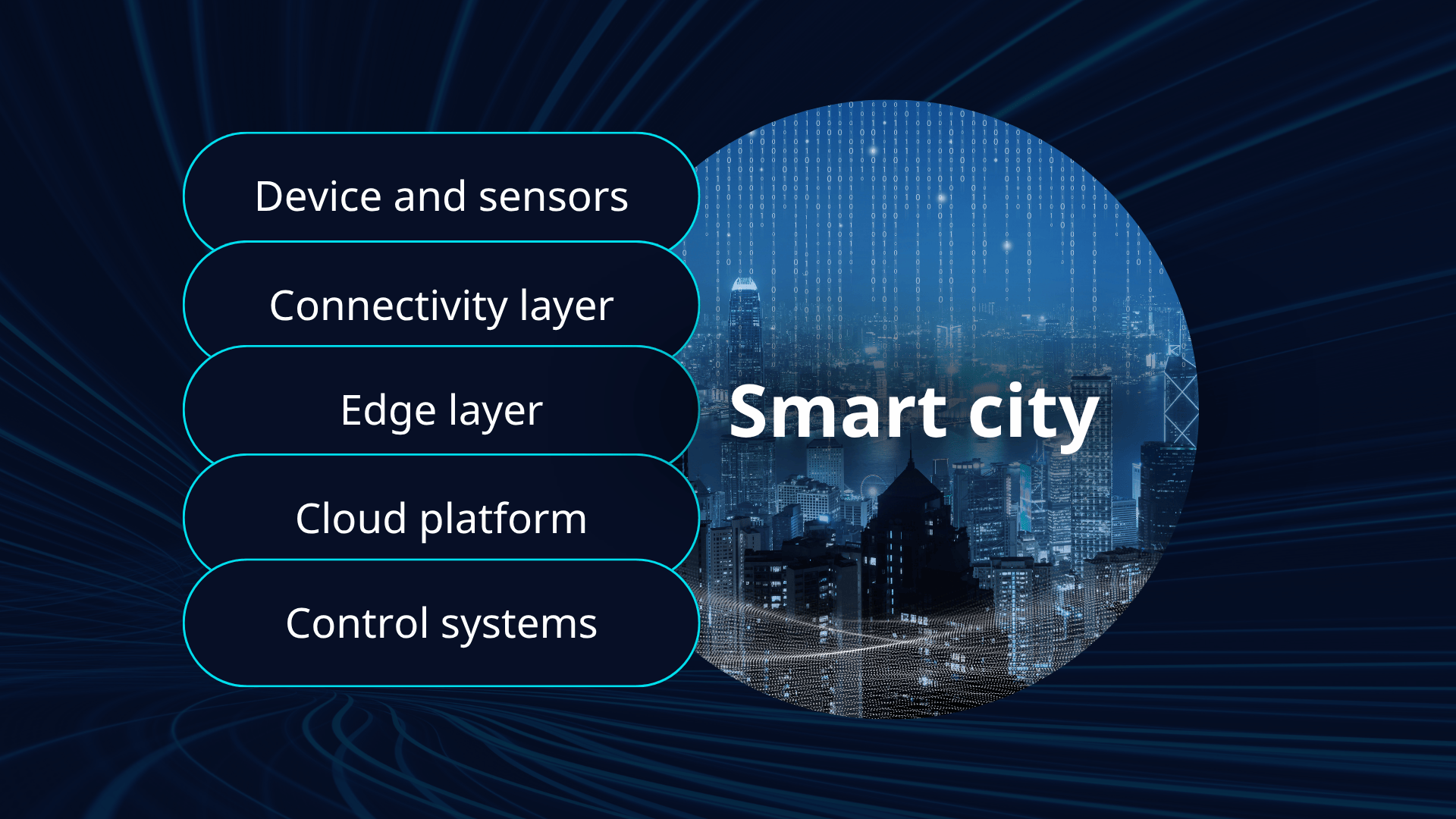
A strong smart city architecture is not built around one technology. It is built around the right combination of cloud, edge, and connectivity.
| Layer | Role in a smart city |
| Devices and sensors | Capture operational data from grid assets, roads, buildings, chargers, and public infrastructure. |
| Connectivity layer | Transports data securely and reliably using cellular, private network, or hybrid links. |
| Edge layer | Processes time-sensitive events locally when low latency matters. |
| Cloud platform | Stores, analyses, coordinates, and visualises city-wide data. |
| Control systems | Turn insights into actions across energy, mobility, safety, and operations. |
This layered model matters because no single component solves the problem on its own. The cloud is powerful, but only when the connectivity and edge architecture underneath it are designed for operational reality.
5G connectivity use cases across smart city operations
Cloud connectivity for smart cities supports a wide range of applications, but the most compelling examples are usually the ones tied to energy, resilience, and public service continuity.
Smart grid management
A modern grid is dynamic, not static. It must absorb renewable generation, support EV charging demand, monitor transformers, and react to faults quickly. Cloud-connected sensors and control systems help utilities balance supply and demand more efficiently, but only if the network can carry time-sensitive data with enough reliability.
EV charging infrastructure
Public charging networks need constant communication for authentication, billing, status updates, power management, and maintenance. As cities expand charging coverage, dependable connectivity becomes essential to avoid downtime and ensure a good driver experience.
Street lighting and public assets
Connected lighting and infrastructure monitoring can reduce energy use and support predictive maintenance. If a luminaire fails or a cabinet is compromised, data should reach the cloud quickly enough to trigger the right response.
Traffic and transport systems
Signals, cameras, parking systems, and roadside sensors all benefit from reliable connectivity. When these systems are connected to cloud platforms, city teams can improve traffic flow, manage incidents faster, and make better planning decisions.
Environmental monitoring
Air quality sensors, flood monitoring devices, and noise platforms can all support better urban policy. The value lies not just in collecting data, but in having a stable connection that keeps the data flowing continuously.
What municipal buyers should ask before deploying
Before rolling out a cloud-connected smart city project, municipal teams should ask a few practical questions:
- Can the network support the latency requirements of the use case?
- How will critical data be isolated from public traffic?
- What happens if one path or carrier becomes unavailable?
- Is the solution scalable across multiple districts or cities?
- How are security, authentication, and device management handled?
- Does the architecture support future services, not just today’s pilot?
Where partner with Transatel:
The pressure on cities is not easing. Electrification is increasing, climate targets are tightening, and residents expect faster, cleaner, more responsive public services. At the same time, urban systems are becoming more distributed and more dependent on real-time data.
That is where an experienced cellular IoT provider becomes relevant. Transatel’s role in this ecosystem is to act as the connectivity layer between urban assets and the cloud platforms that manage them, helping cities move critical data securely and reliably across 4G and 5G networks.
For organisations planning smart city deployments, this kind of foundation matters because it reduces fragmentation, supports international expansion, and helps align operational needs with network performance.
Editor’s final thoughts:
The smartest cities will not be the ones with the most sensors. They will be the ones with the best connection between what happens in the field and what happens in the cloud.
Cloud connectivity for smart cities is that bridge. When it is secure, low-latency, and built to scale, cities can move from reactive operations to intelligent control.
If you are planning a smart city, utility, or urban infrastructure project and want to understand the right connectivity architecture, book a meeting with Transatel’s global connectivity experts to discuss the best approach for your deployment.