Automotive
 Aviation
 Defense & Public Safety
 Manufacturing
 Logistics
 Public Transport
 Mobility
 Energy & Utilities
 Smart Farming
 Smart Buildings
 EV charging
 Healthcare
 Retail
 Media & entertainment

When you tap your phone to unlock a smart door, track your amazon delivery truck in real time, or adjust factory machines from a dashboard miles away, you’re using the power of IoT architecture without even realizing it.
Think of a modern farmer monitoring soil moisture through sensors that trigger automated irrigation systems before crops dry out. Or a logistics company tracking perishable goods across continents with temperature alerts that prevent spoilage. In smart cities, IoT architecture connects traffic lights, air quality sensors, and utility grids so that entire urban systems can self-adjust and run more efficiently.
All these solutions rely on a structured network design – a layered ecosystem of devices, networks, and platforms that make data flow seamlessly and securely. That blueprint is what we call IoT architecture.
What is IoT architecture?
Simply put, IoT architecture is the framework that defines how devices, networks, and applications interact in an Internet of Things ecosystem. It connects the physical world (sensors, machines, wearables, vehicles) to the digital world (cloud platforms, analytics, dashboards, and enterprise applications).
At its core, IoT architecture ensures data travels from a connected “thing” to where decisions are made. Whether it’s an industrial robot on a 5G network or a smart thermostat in your home, every IoT solution follows these same principles of communication, security, and control.
A well-designed IoT architecture matters because it determines how scalable, reliable, and secure your IoT deployment will be – qualities that can make or break anything from a global connected car program to a local energy monitoring project.
The layered structure of IoT architecture
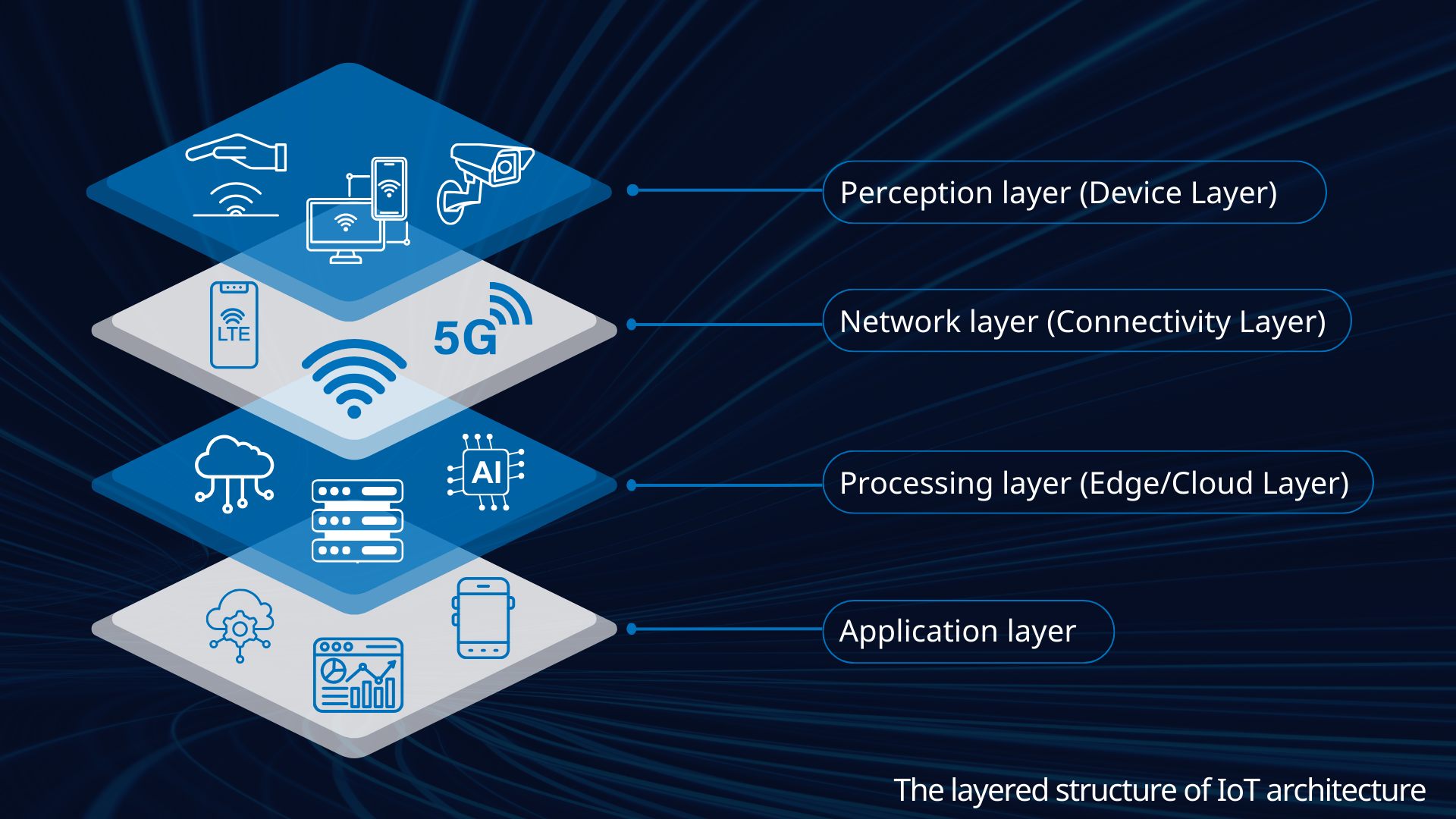
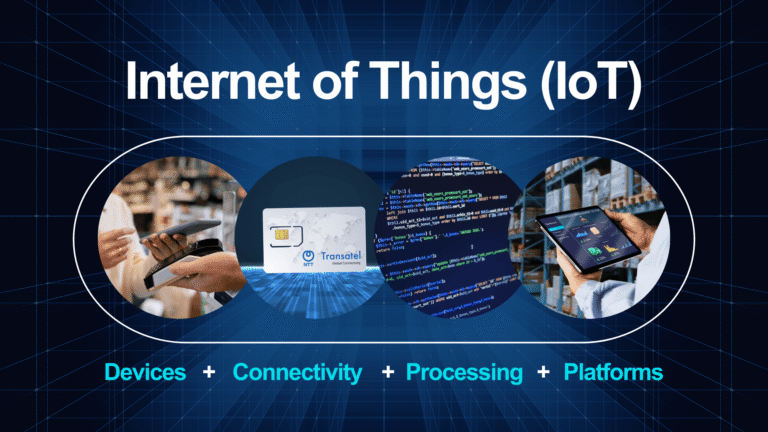
IoT architecture typically consists of four foundational layers. Each has a unique role but works as part of a continuous data flow loop.
| Layer | Description | Examples |
| Perception layer (Device Layer) | The physical “sensing” layer where real-world data is collected through sensors and actuators. | Sensors, RFID tags, cameras, smart devices |
| Network layer (Connectivity Layer) | Transports collected data securely across local or wide-area networks. | LTE-M, 4G, 5G, Wi-Fi, LPWAN, satellite connections |
| Processing layer (Edge/Cloud Layer) | Analyzes and filters data before storage or real-time response. | Edge servers, cloud computing, AI analytics |
| Application layer | Converts processed data into actionable insights for users or systems. | Dashboards, APIs, enterprise software, mobile apps |
Each layer must cooperate seamlessly. When data is delayed, lost, or misinterpreted, operations can halt. That’s why IoT architecture isn’t just a technical map – it’s a foundation for trust and performance.
Layer 1: The perception layer
This layer is where sensing begins. Devices capture environmental, mechanical, or biological data – temperature, location, acceleration, vibration, light, and more. In industrial IoT, this could mean monitoring equipment vibration to predict failures before they occur. In consumer IoT, it might be a smartwatch measuring heartbeat and motion.
The challenge lies in power efficiency, data accuracy, and longevity. Sensors at this layer are often deployed in difficult-to-reach places (mountaintops, offshore rigs, vehicle interiors). Reliable design and resilient connectivity are vital to ensure consistent data capture with minimal maintenance
Layer 2: The network layer
Once data is collected, it must be moved. The network layer ensures that this journey from device to platform is seamless, secure, and reliable. Depending on the use case, IoT systems employ cellular standards like LTE-M, 4G, and 5G, or alternatives such as LPWAN, NB-IoT, or satellite links.
Choosing connectivity is not about picking the most powerful network – it’s about matching bandwidth, latency, and cost to the device’s needs. For example, a connected streetlight may only transmit small packets of data periodically, while a connected car sends continuous streams of telemetry. IoT architecture adapts to both by integrating diverse network types within one coherent system.
Security is also enforced here – through device authentication, encrypted transmission, and roaming management across multiple networks.
Layer 3: The processing layer
This is where intelligence meets data. Once information reaches the processing layer, it’s filtered, aggregated, and analyzed – often using edge computing or cloud infrastructure.
Edge computing plays a crucial role in reducing latency by processing information closer to where it’s generated. Imagine an autonomous drone adjusting its path instantly to avoid an obstacle. That decision cannot wait for a cloud response; it needs local computing.
Meanwhile, the cloud complements the edge by storing large datasets, applying machine learning models, and enabling centralized management. The hybrid of both – edge plus cloud – forms the backbone of real-time, scalable IoT systems.
Layer 4: The application layer
At this top layer, data transforms into meaning. Dashboards, APIs, or AI-driven applications turn sensor readings into insights – detecting patterns, predicting outcomes, and triggering automated responses.
For example, an energy provider might use this layer to visualize grid performance and automatically reroute power during peak demand. A logistics company could feed IoT data into an ERP or CRM system to enhance delivery of transparency for customers.
The value of IoT lies not in data collection, but in data interpretation and action – and that is where the application layer shines.
Common IoT communication models
IoT architecture also depends on how devices communicate with one another and the cloud. Three major communication models are used:
- Device-to-Device (D2D): Devices connect directly, often through Bluetooth or Zigbee. Example: smart home devices communicate locally.
- Device-to-Gateway: Devices connect to a gateway that manages data transfer to the cloud. Used widely in factories or vehicles.
- Device-to-Cloud: Devices connect directly to remote servers through cellular or satellite networks, suitable for mobile or distributed assets.
A mature IoT architecture often combines all three models for flexibility and resilience.
The evolution of IoT architecture
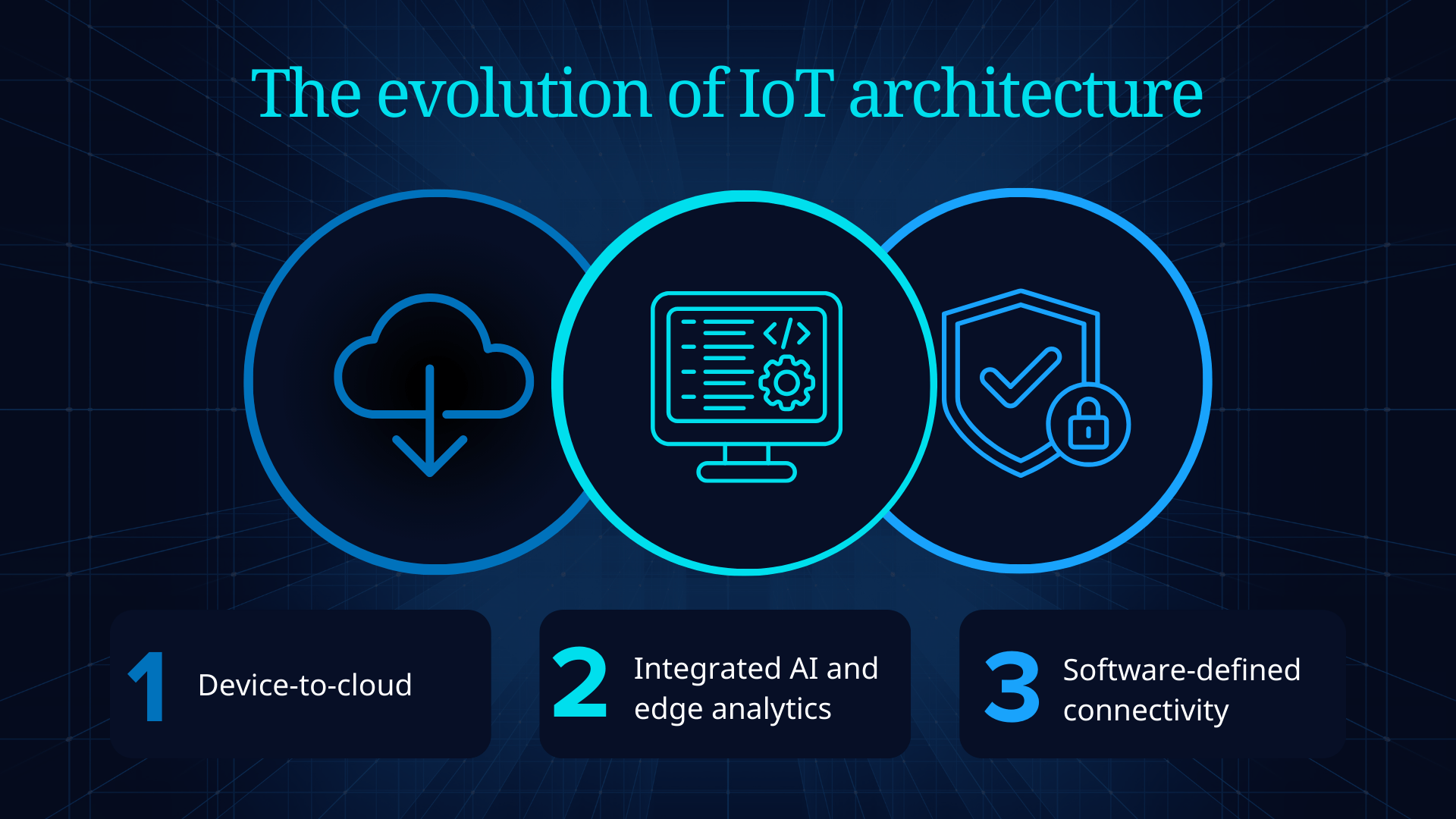
IoT architecture is constantly evolving. Early systems focused on simple device-to-cloud connections. Today, we’re seeing distributed architectures with integrated AI and edge analytics, offering lower latency and autonomous decision-making.
Tomorrow’s IoT will hinge on software-defined connectivity, private networks, and seamless integration between IT and OT ecosystems. Scalability will depend not only on hardware and sensors but also on how intelligently the entire architecture is orchestrated.
Forward-looking organizations are investing in flexible, carrier-grade infrastructure that can adapt to emerging technologies while maintaining stability across global deployments.
Time to build your IoT foundation
Every connected product, fleet, or system begins with Transatel’s solid architecture. It’s the invisible framework that determines whether your IoT project thrives or struggles. Whether your business is designing the next generation of connected equipment or scaling existing deployments globally, strong, adaptive IoT architecture is the differentiator.
If you’re looking to optimize your IoT architecture, book a conversation with our team of IoT connectivity experts. We’ll help you shape a connected ecosystem that’s not only smart but built to last.