Automotive
 Aviation
 Defense & Public Safety
 Manufacturing
 Logistics
 Public Transport
 Mobility
 Energy & Utilities
 Smart Farming
 Smart Buildings
 EV charging
 Healthcare
 Retail
 Media & entertainment

The connected vehicle is no longer defined by hardware alone. Over‑the‑air updates, real‑time navigation, in‑car Wi‑Fi, advanced driver assistance and emergency calling all rely on a single foundation: cellular connectivity. For global automotive OEMs managing millions of vehicles across dozens of markets, brands and regulatory regimes, connectivity has evolved from a technical add‑on into a strategic pillar. It now directly influences product safety, regulatory exposure, brand experience and long‑term cost structure.
Yet most connectivity operating models were never designed for this reality. Telecom ecosystems were built around consumer devices with short lifecycles, limited geographic scope and stable regulatory assumptions. Automotive programmes operate on a completely different timescale and complexity curve. Vehicles are produced in one region, sold in another and supported worldwide for lifecycles exceeding fifteen years. During that time, networks, regulations and technologies will inevitably change. Connectivity must withstand all of it.
Today, leading OEMs are rethinking how connectivity is architected, governed and delivered – not as a service, but as critical infrastructure.
Regaining Control Over Connectivity Operations
For years, OEMs have depended on operator‑centric IoT platforms to manage vehicle connectivity. Provisioning workflows were often manual or semi‑automated. Visibility into SIM and profile states was limited. Profile management relied on offline exchanges of IMEI, eID and serial number data, creating bottlenecks and operational risk at scale. What was presented as managed service delivery frequently masked vendor lock‑in, leaving OEMs dependent on a single telecom operating model and unable to evolve their platform autonomously.
As fleets scale into the millions, these constraints become structural. Large‑scale campaigns such as activations, service changes or fleet migrations are difficult to execute reliably. Cost attribution across brands and regions lacks transparency. Governance becomes fragmented. Most critically, OEMs are unable to switch or add network providers without redesigning their platform or disrupting live vehicles.
Leading OEMs are now pushing for a fundamental architectural shift. In the emerging model, the OEM connectivity platform becomes the master orchestrator. Mobile network operators are reduced to programmable infrastructure layers beneath it. Every operation – activation, suspension, profile switching, service plan assignment and lifecycle events – must be accessible through open, standards‑based APIs. Proprietary portals, opaque processes and operator‑specific constraints are no longer acceptable.
Transatel’s approach is built around this principle. By delivering a fully API‑driven, GSMA SGP.32‑compliant connectivity layer, Transatel enables OEMs to integrate connectivity management directly into their own platforms while benefiting from a unified operational abstraction. Multiple MNOs and connectivity management platforms are aggregated into a single operational layer, providing comprehensive visibility and control across regions and providers. OEMs retain full ownership of profile policies, including the ability to enable, disable, delete or migrate profiles without operator intervention. eUICC provisioning is automated end‑to‑end, eliminating offline workflows and manual reconciliation.
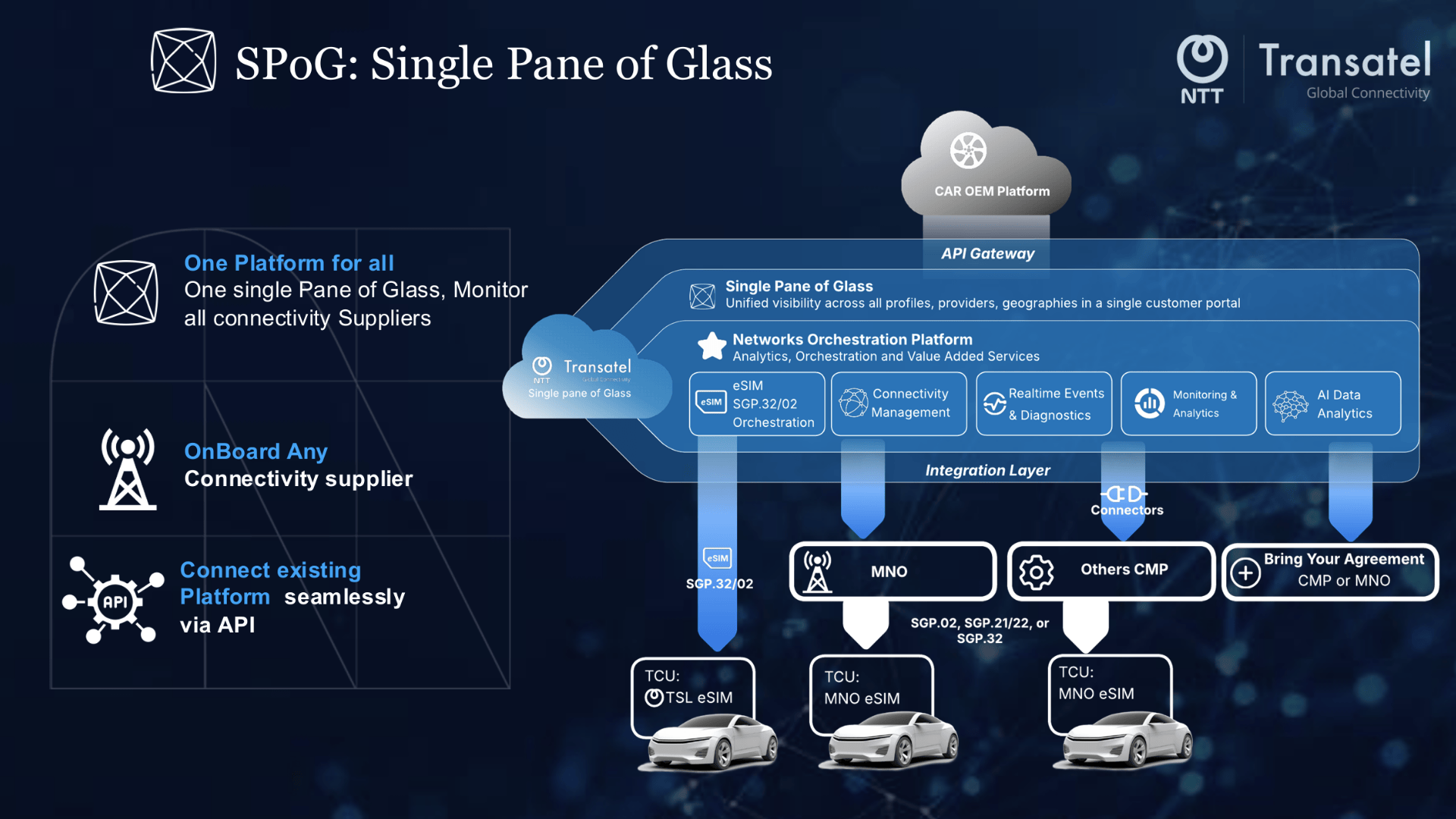
The result is telecom‑grade capability without telecom complexity – infrastructure designed for orchestration rather than confinement
Scaling Operations Across Millions of Vehicles
The operational reality of global automotive connectivity is inherently complex. OEMs manage millions of eUICCs across dozens of brands, each mapped to distinct legal entities, commercial agreements and service definitions. Vehicle lifecycles extend far beyond typical telecom contract durations. At the same time, multiple connectivity services must coexist on the same hardware platform: embedded B2B services, consumer connectivity and emergency calling.
Traditional telecom models do not scale to this reality. OEMs require governance frameworks that support multi‑brand hierarchies, industrial‑grade automation and precise cost and usage visibility across the full vehicle lifecycle. Connectivity operations must enable testing, simulation and staged deployment without disrupting live fleets. They must also support safe transitions from factory state to live service and, eventually, orderly end‑of‑life management.
Transatel addresses these requirements with an automotive‑grade operational architecture designed specifically for long‑lifecycle global fleets. The platform supports complex organisational hierarchies, flexible lifecycle states and granular reporting across regions and services. Fleet‑wide actions, campaign management and operational accountability are core design principles, not afterthoughts. Professional services complement the platform to support country‑specific regulatory processes, including eCall and Next‑Generation eCall deployment, testing and certification.
Connectivity operations are aligned with automotive timelines rather than telecom contract cycles – a fundamental but often overlooked distinction.
Eliminating Regulatory and Tax Exposure on Consumer Services
One of the most underestimated challenges in automotive connectivity is the regulatory burden associated with consumer services. When OEMs offer in‑car Wi‑Fi or consumer data packages, someone must legally act as the telecommunications service provider – bringing Merchant of Record obligations, VAT and telecom‑specific taxes, ISP registration requirements, and Know Your Customer responsibilities across each market.
OEMs rightly seek to avoid this exposure, as regulatory and financial risks scale with every additional country. They need a telecom partner to assume primary legal responsibility for B2C service provision while the end‑customer experience remains fully OEM‑branded.
Transatel delivers exactly this model. As the legal provider of consumer connectivity, Transatel assumes responsibility, within the applicable contractual and regulatory framework, for telecom licensing, taxation, consumer protection, and data privacy compliance across all operational markets. KYC frameworks are designed collaboratively with each OEM, taking into account regional requirements – whether EU data protection rules, APAC real‑name registration mandates, or North American anti‑fraud obligations – and aligned with the OEM’s brand and customer journey. Terms and conditions are delivered through APIs and deep links for seamless integration into OEM digital channels.
The precise allocation of responsibilities remains governed by contractual terms, and certain obligations tied to the OEM’s own digital channels may remain within its scope. That said, the core telecom regulatory burden – licensing, tax remittance, KYC, and roaming compliance - is addressed by Transatel. The OEM protects its brand; Transatel protects the OEM.
Delivering Mission‑Critical Emergency Services
Emergency calling is not a feature. It is a legal obligation, a life‑safety service and a defining moment for the vehicle brand. Expectations are absolute: reliable call completion, accurate transmission of vehicle data, robust fallback mechanisms and guaranteed callback capability. Failures are immediately visible – not just as service incidents, but as regulatory breaches and reputational crises.
Emergency services therefore demand carrier‑grade design principles: geographic redundancy, assured routing, predictable capacity and continuous monitoring. They also require alignment with country‑specific certification and regulatory frameworks. Best‑effort connectivity models are insufficient.
Public eCall and Next‑Generation eCall services are delivered by local MNOs in accordance with national regulations. Transatel complements this ecosystem by enabling OEMs to deploy private eCall, bCall and assistance services, offering greater control over user experience, service logic and cross‑border consistency.
Transatel’s architecture is designed to support emergency services in roaming environments. While leveraging partner MNOs for public eCall handling, the platform ensures robust connectivity, fallback mechanisms including SMS and packet‑switched data, and secure routing to OEM‑operated service centres through geographically redundant interconnections. Every critical element, from connectivity orchestration to interconnection, is built with resilience and scalability in mind. When seconds matter, infrastructure cannot be best‑effort – it must be dependable by design.
Building for a Future That Has Not Been Defined Yet
Perhaps the most consequential challenge OEMs face is the future itself. Vehicle platforms designed today must remain operational and compliant for more than a decade, while the connectivity landscape continues to evolve. 5G Standalone, network slicing, non‑terrestrial networks and direct‑to‑device satellite connectivity are reshaping capabilities. Legacy networks will sunset. Roaming regulations will change. OEMs must be prepared to migrate between network providers mid‑programme without hardware redesign or service disruption.
The cost of lock‑in is now well understood. Proprietary integrations, non‑portable profiles and tightly coupled architectures force costly replatforming cycles and constrain strategic flexibility. Future‑proofing is not about predicting the next technology; it is about designing architectures that absorb change without disruption.
This is the scope of CMP 2030, Transatel’s consulting and professional services programme created to help OEMs define migration‑ready connectivity architectures. Built on GSMA SGP.32 compliance, Transatel’s architecture enables profile portability, zero‑touch reuse and seamless MNO migration. CMP 2030 supports OEMs in planning 5G SA adoption, legacy network transitions, non‑terrestrial integration and regulatory change management – without recalls or service interruption.
A Partnership Model for the Next Decade
Operational control, fleet‑scale automation, regulatory protection, mission‑critical safety, and future‑ready architecture are inseparable challenges. Together, they define a single question: can your connectivity partner sustain global automotive programmes at scale and over time?
Transatel’s value proposition is an architectural commitment: API‑first integration, GSMA standards compliance, carrier‑grade emergency services, and full B2C regulatory ownership – combined with a migration‑ready design that protects OEM investments across vehicle generations. Through CMP 2030, Transatel also supports OEMs with long‑term consulting expertise in connectivity and platform strategy, helping them anticipate technology shifts, regulatory change, and platform evolution.
The question is no longer whether these capabilities matter – but whether your current partner can deliver them sustainably over the next decade.
If your organisation is architecting its next‑generation connected vehicle platform, Transatel welcomes a technical dialogue. The complexity is real. The solutions should be equally concrete. Click here to contact our global automotive connectivity experts!