Automotive
 Aviation
 Defense & Public Safety
 Manufacturing
 Logistics
 Public Transport
 Mobility
 Energy & Utilities
 Smart Farming
 Smart Buildings
 EV charging
 Healthcare
 Retail
 Media & entertainment


Imagine remote pipelines stretching thousands of miles, with IoT sensors detecting leaks to avert disasters. A single exploited vulnerability floods the system with false alerts or shuts valves remotely: production halts for days, $10M in downtime, EPA fines for “negligent spills,” and stock dips 15%. These stakes demand robust IoT security solutions, the fortified defenses – think digital locks, real-time monitors, and adaptive shields – that protect internet-connected devices and their data flows from unauthorized access and attacks.
Transatel, as a global cellular connectivity provider, has securely connected millions of devices and vehicles worldwide. This detailed guide breaks down IoT security solutions layer by layer, blending technical precision with stories from farms to factories.
Core Components of IoT Security Solutions
Building robust IoT security starts with foundational layers. Encryption scrambles data in transit and at rest, making intercepted info useless to thieves. For example, AES-256 standards turn device communications into gibberish without the right key. Authentication verifies every device before it joins the network, often using digital certificates or multi-factor checks.
Firmware integrity checks go further, scanning for tampering during boot-up. Over-the-air (OTA) updates push patches automatically, closing vulnerabilities before exploits spread. Then there is segmentation: dividing networks into zones so a breach in one thermostat does not doom the entire warehouse. These elements form a defense-in-depth approach, where multiple barriers slow attackers down.
| Component | Purpose | Key Benefit | Example Tech |
| Encryption | Secure data flow | Prevents eavesdropping | TLS 1.3, AES-256 |
| Authentication | Verify identities | Blocks imposters | X.509 certificates, OAuth |
| Firmware updates | Patch vulnerabilities | Stops known exploits | OTA via secure channels |
| Network segmentation | Isolate zones | Limits breach spread | VLANs, micro-segmentation |
| Anomaly detection | Spot unusual activity | Early threat alerts | AI-based behavioral analysis |
Emerging Tech Powering IoT Security
Innovation keeps pace with threats. AI-driven anomaly detection watches traffic patterns, flagging odd behaviors like a sensor suddenly flooding data. Machine learning models train on normal operations, then alert on deviations, reducing false alarms over time. Blockchain adds tamper-proof ledgers for device identities, ensuring no one fakes credentials.
Edge computing processes data locally on devices, cutting latency and exposure to cloud hacks. Zero-trust architecture assumes no one is trustworthy, requiring constant proof from every endpoint. Quantum-resistant algorithms prepare for future computers that could crack current encryption. These tools turn reactive security into proactive fortification.
Real-World Use Cases Across Industries
IoT security solutions shine brightest in action. In manufacturing, predictive maintenance sensors on assembly lines use encrypted channels to report wear-and-tear data. A breach could halt production, but solutions like IP whitelisting and VPN tunnels keep intel flowing safely to central dashboards. One global automaker secures millions of vehicle telematics units this way, preventing remote hijacks.
Logistics fleets rely on GPS trackers and temperature monitors for perishable goods. Secure eSIMs enable seamless network switching across borders, with built-in kill switches to quarantine compromised units. In healthcare, remote patient monitors transmit vitals via zero-trust links, ensuring HIPAA compliance while enabling real-time interventions.
Energy grids deploy smart meters that detect physical tampering or cyber intrusions, using anomaly detection to prevent blackouts. Agriculture leverages soil sensors in vast fields, protected by low-power segmentation to withstand remote farm hacks. Smart cities coordinate lights, waste bins, and cameras with multi-layered defenses, avoiding the chaos of a single-point failure. These examples show tailored applications scaling from single farms to global operations.
Common Challenges and How to Overcome Them
No solution is perfect. Legacy devices resist updates, creating gaps. Solution: Bootstrap provisioning loads security profiles during manufacturing. Resource constraints on battery-powered IoT mean heavy encryption drains power. Lightweight protocols like DTLS balance security and efficiency.
Scalability hits when deploying millions of units. Cloud-based management platforms centralize control, automating policy enforcement. Compliance varies by region; GDPR in Europe demands strict data handling, while U.S. NIST frameworks emphasize resilience. Regular audits and penetration testing bridge these hurdles.
How to tackle IoT security threats:
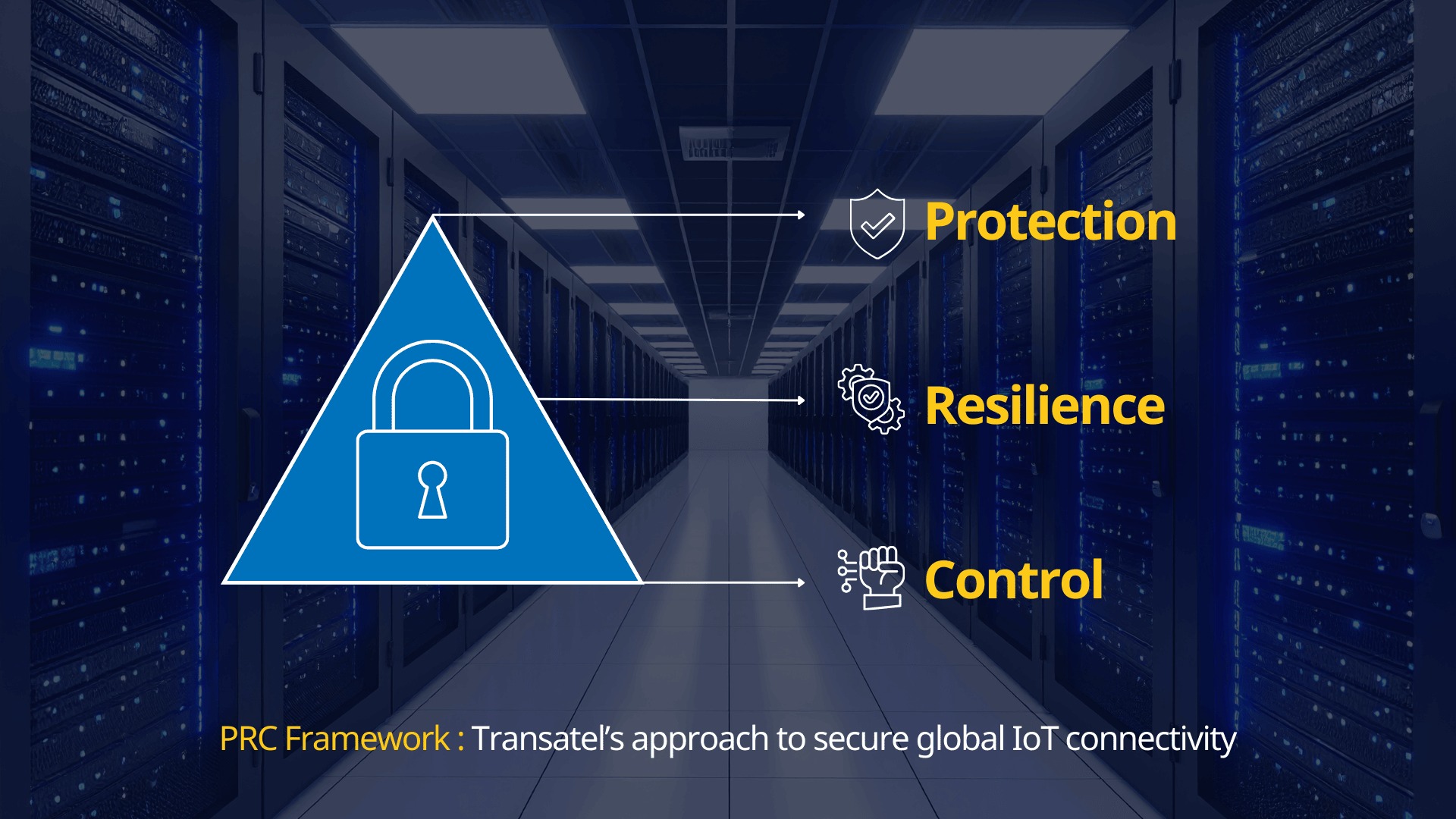
At Transatel, our approach to secure, global IoT connectivity is guided by the PRC framework – a foundation built on three key pillars:
- Protection: Your data remains confidential and always protected, from the SIM to the cloud. Our security layers encrypt communication across networks and manage access intelligently to prevent misuse.
- Resilience: We design networks to ensure your data stays reliably accessible, even during disruptions. Built-in redundancy, intelligent routing, and proactive monitoring safeguard uptime at global scale.
- Control: Your data and connectivity stay under full control within our secure infrastructure. Transatel’s architecture adheres to regional compliance and privacy standards, ensuring governance across borders.
The PRC framework isn’t just a concept – it’s embedded in how we architect and operate global IoT connectivity. It fortifies every connection, helping enterprises build secure, compliant, and future-ready IoT ecosystems.
Future-Proofing Your IoT Deployments
Looking ahead, 5G and satellite integration amplify IoT scale but introduce new vectors. Hybrid networks blending terrestrial and non-terrestrial coverage need unified security overlays. Regulations like the EU’s Cyber Resilience Act will mandate baseline protections, pushing providers to innovate.
Start by assessing your attack surface: inventory devices, map data flows, and prioritize high-risk assets. Partner with platforms offering end-to-end visibility, from SIM provisioning to runtime monitoring. Simulate attacks through red-team exercises to test defenses.
IoT security solutions evolve quickly, but the principles endure: layer defenses, automate responses, and stay vigilant. Global deployments demand partners with proven scale, handling everything from device onboarding to cross-border compliance.
Ready to secure your IoT ecosystem? Book a meeting with our IoT security experts today and stay ahead of tomorrow’s threats.