Automotive
 Aviation
 Defense & Public Safety
 Manufacturing
 Logistics
 Public Transport
 Mobility
 Energy & Utilities
 Smart Farming
 Smart Buildings
 EV charging
 Healthcare
 Retail
 Media & entertainment
Picture a logistics company tracking 5,000 containers across Europe, Asia and the Americas. One day, a partner network in a key market changes its terms.
On a multi-IMSI setup, the fix means pushing a new profile to every SIM over the air while the devices are on the move. Some containers are sitting in a port with no signal, and others miss the update entirely.
On a mono-IMSI setup, the same change happens overnight in the core network. Not a single SIM needs to be touched.
Most teams choosing an IoT SIM compare coverage maps and data prices. The decision that really shapes long-term operations sits one layer deeper: how many identities your SIM carries, and where the switching intelligence lives. This guide explains multi-IMSI vs mono-IMSI in plain terms, so you can choose the right architecture for your fleet.
What is an IMSI and how does it work?
An IMSI (International Mobile Subscriber Identity) is the unique identity stored on every SIM card. Think of it as the SIM’s passport number. It’s the number a mobile network checks to decide whether a device can connect and who to bill.
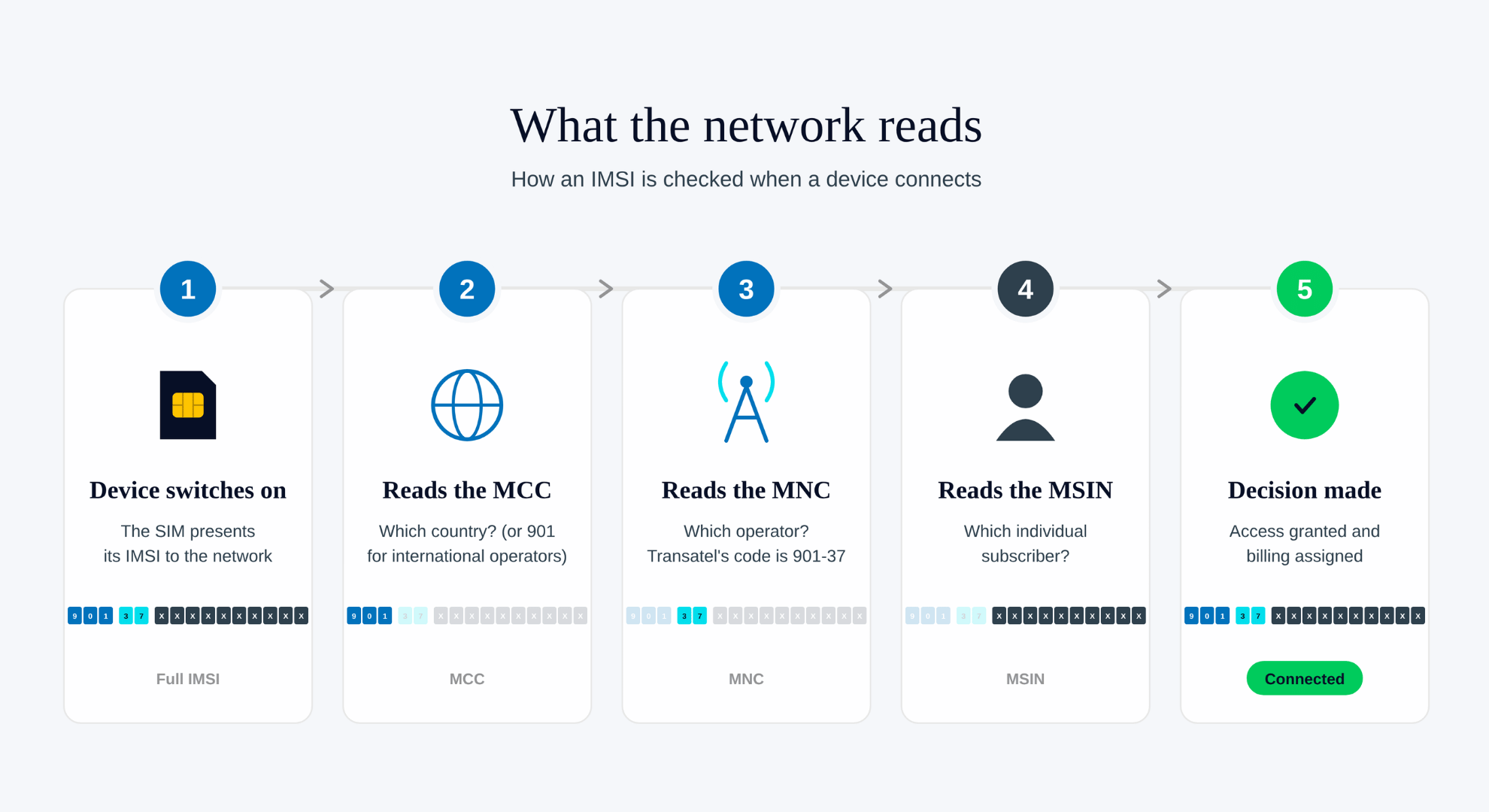
An IMSI is up to 15 digits long and is built from three blocks:
- MCC (Mobile Country Code): 3 digits identifying the country, or 901 for international operators.
- MNC (Mobile Network Code): 2 or 3 digits identifying the operator. Transatel’s network code is 901-37.
- MSIN (Mobile Subscriber Identification Number): the individual subscriber number.
Mono-IMSI and multi-IMSI: two ways to connect globally
- Mono-IMSI (single IMSI): the SIM carries one global identity. When the device travels, it connects to local networks through roaming agreements, and network selection is managed centrally in the operator’s core network.
- Multi-IMSI: a multi-IMSI SIM card stores several IMSI profiles from different operators. A SIM applet performs an automatic switch between them, typically to use a local IMSI when entering a given country.
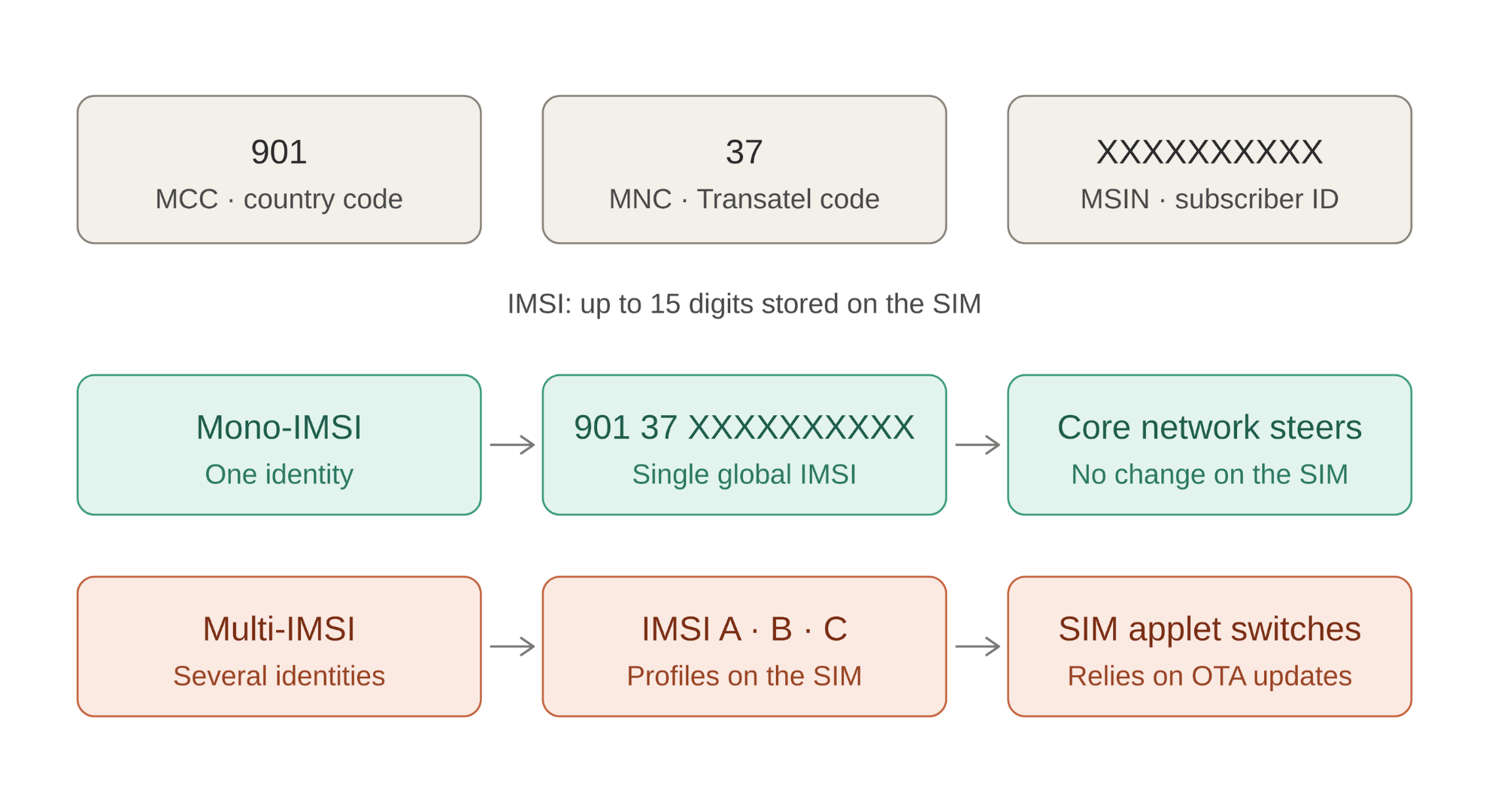
Multi-IMSI vs Mono-IMSI: the key differences
| Multi-IMSI | Mono-IMSI | |
| Where the intelligence sits | Software running on the SIM itself | The operator’s core network, so the SIM stays simple and standard |
| Adding coverage | A long, custom integration with a mobile network operator, often several months | A standardised operation that follows the GSMA framework |
| Updating the SIM | Depends on OTA (over-the-air) updates, which only work if the device has coverage at that exact moment | No OTA update needed when coverage changes |
| Device compatibility | Requires devices that support OTA campaigns and specific SIM toolkit features | A fully standard SIM, unaffected by device quirks |
| Supplier independence | Using another carrier’s IMSI ranges usually comes with long-term partnership commitments | Standard roaming agreements, so partners can be changed without touching the fleet |
The benefits of Mono-IMSI for IoT
Network redundancy without complexity
With a single global IMSI, a device can access several networks in each country. If one network goes down, the SIM attaches to another available one. Network redundancy is built in at the core, not managed through profile juggling on the device.
No physical swap, no risky OTA campaigns
Every OTA update is a moment where something can go wrong: devices out of coverage, interrupted downloads, or APN settings being wiped, as some device makers report. Mono-IMSI removes these operations entirely, and a physical swap of the SIM is never needed to add new destinations.
Faster time to market
New destinations are activated at network level. When a country is added to the footprint, the SIMs already deployed in the field recognize it automatically, with no action on the customer’s side.
Cost optimization over the full lifecycle
Local IMSI rates can look attractive on a pricing sheet, but the hidden costs add up: integration projects, OTA campaigns, field interventions and supplier lock-in. A mono-IMSI model keeps operating costs predictable and offers a clearer path to cost optimization as the fleet grows. Roaming fees are negotiated centrally rather than profile by profile.
Freedom to switch partners
Because connectivity relies on standard roaming agreements, replacing a network partner in a given country can be done overnight at the network level, without swapping or reprogramming a single SIM.
Use cases: where the choice makes the difference
- Connected vehicles and logistics: trucks, trailers and containers crossing borders every day need to stay connected without depending on a successful profile switch at each frontier.
- Industrial equipment and energy: generators, EV chargers and smart meters are often deployed in hard-to-reach locations, where sending a technician for a SIM issue is costly.
- Robotics and autonomous machines: fleets deployed across multiple sites need consistent connectivity and centralized management to scale quickly.
- Regulated markets: some countries, such as Brazil, restrict permanent roaming. Here, a hybrid approach combining a global IMSI with a local profile, delivered via eUICC and remote provisioning, provides local compliance while keeping a single point of management.
Transatel’s mono-IMSI IoT SIM: one partner, one identity, global reach
Transatel’s multi-network IoT SIM is built on a mono-IMSI approach, powered by its fully owned core network. With direct network access agreements with hundreds of mobile carriers, the SIM connects devices to 2G, 3G, 4G, 5G networks across 200+ countries and territories.
For markets where local rules require it, Transatel’s IoT eSIM, based on the GSMA SGP.32 standard, adds remote provisioning of local profiles, with the same single platform, support team and contract. Everything is managed through Transatel’s SIM management platform or integrated into your own tools via API.
Choosing the right SIM architecture
Choosing between multi-IMSI and mono-IMSI isn’t only a technical decision. It determines how easily your fleet can grow, adapt and stay online for years to come.
Book a FREE consultation with our global connectivity experts to find the right SIM strategy for your IoT deployment.
A mono-IMSI SIM carries one global identity and connects to local networks through roaming agreements, with network selection managed in the operator’s core network. A multi-IMSI SIM stores several operator profiles and uses an applet on the SIM to switch between them, usually to a local IMSI in each country.
An OTA update only works if the device has coverage at that exact moment. Devices may be out of coverage, downloads can be interrupted, and some device makers report APN settings being wiped. Each update is a point where something can go wrong.
Not always. Multi-IMSI SIMs need devices that support OTA campaigns and specific SIM toolkit features. A mono-IMSI SIM is fully standard, so device quirks don’t affect how it works.
With a single global IMSI, a device can access several networks in each country. If one network goes down, the SIM attaches to another available network. This redundancy is built into the core network, so the device never has to manage profiles.
With multi-IMSI, integrating a new IMSI means a long, custom integration with a mobile network operator, which often takes several months. With mono-IMSI, adding a country is a standardized operation that follows the GSMA framework, so new destinations can be activated faster.