Automotive
 Aviation
 Defense & Public Safety
 Manufacturing
 Logistics
 Public Transport
 Mobility
 Energy & Utilities
 Smart Farming
 Smart Buildings
 EV charging
 Healthcare
 Retail
 Media & entertainment

In an increasingly digital and service-driven mobile ecosystem, certain legacy technologies continue to play a critical role. Premium SMS is one of them.
While often perceived as a legacy billing mechanism, Premium SMS remains deeply embedded in the UK market, supporting a wide range of everyday interactions from charity donations and media engagement to mobile payments and subscription services
Yet, many MVNOs still do not offer this capability.
What is Premium SMS and why does it matter more than ever in 2026?
Premium SMS (PSMS) is a charged messaging service where the cost is added to the subscriber’s mobile bill or deducted from their prepay balance. Unlike standard SMS, PSMS routes through a shared infrastructure between the mobile operator, an aggregator, and a merchant, enabling seamless micropayment and engagement flows without app downloads or card details.
A service still widely used across industries
- Premium SMS continues to underpin multiple high-volume use-cases in the UK: Charity donations (text-to-donate)
- TV voting and interactive services
- Competitions and campaigns
- Subscriptions and alerts
- Mobile-based micropayments (i.e. parking)
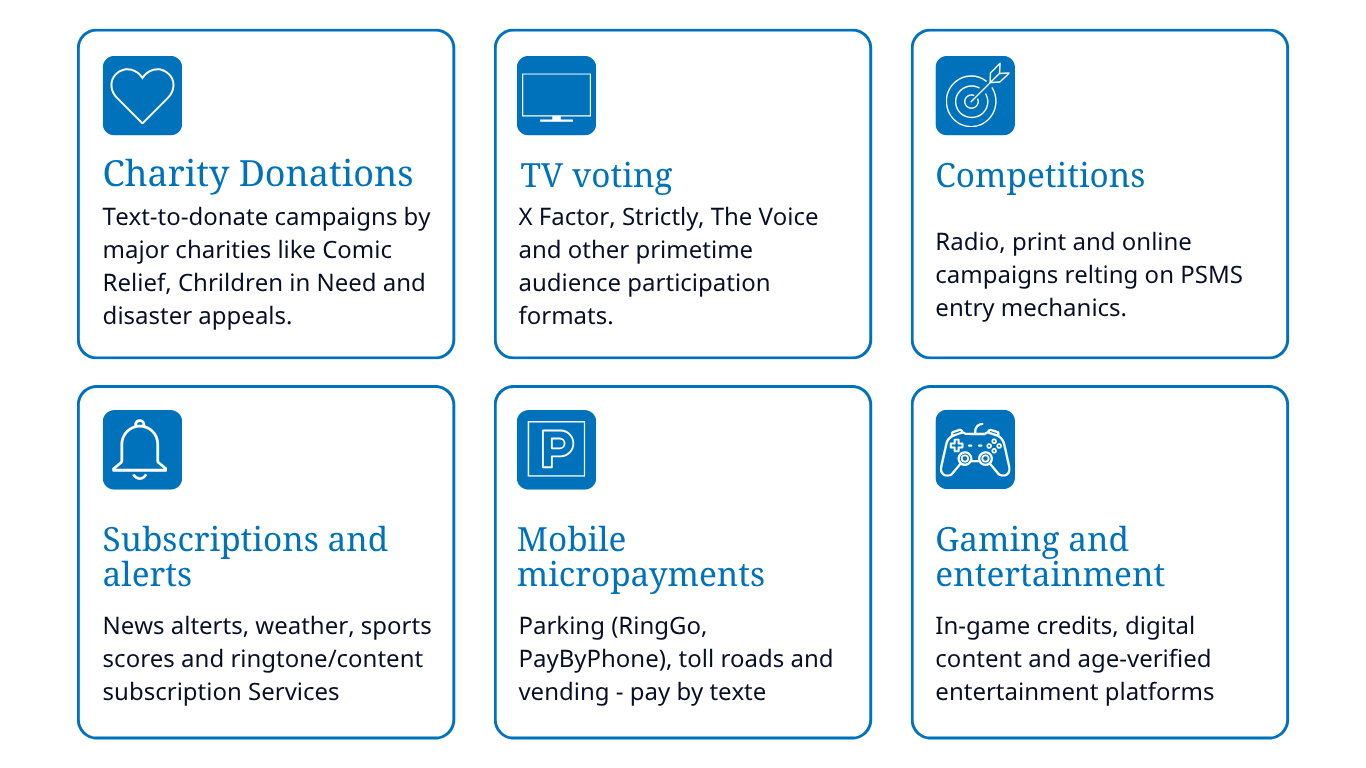
These services are not niche, they are part of the standard mobile experience expected by consumers.
From feature gap to competitive advantage
For MVNOs, enabling Premium SMS is not just about adding a new feature, it is about:
- Ensure full parity with MNO offerings
- Avoid service limitations for your subscribers
- Enable new revenue-generating use cases
In a highly competitive market, missing such a core capability can directly impact customer experience and brand perception.
The hidden impact of not supporting Premium SMS
For MVNOs, the absence of Premium SMS is not always immediately visible, but its impact is real.
| Without Premium SMS – Risks | With Premium SMS Enabled – Gains |
| Subscribers fail to complete charity donations, creating negative brand negotiations | Full feature parity with MVNO offerings with no gap in subscribers expectations |
| Exclusion from TV voting creates visible, social moments of service inadequacy | Stronger brand trust through seamless real world service delivery |
| Parking and micropayment failures cause friction in daily life scenarios | New revenue generated use cases built on Premium SMS flows |
| Perception of a second-class network versus MNO peers | Reduced churn among engaged, media-active subscribers segments |
| Higher churn risks among heavy media and charity -engaged demographics | Competitive differentiation versus MVNO still missing the capability |
| Loss of potential premium SMS revenue share opportunities | Built-in controls reduce customer complaints and bill dispute costs |
Subscribers may:
- Be unable to complete common actions (e.g. donating, voting)
- Experience inconsistencies compared to MNO users
- Perceive the service as limited or incomplete
Over time, this can translate into:
- Increased customer dissatisfaction
- Higher churn risk
- Reduced competitiveness in the market
In a mature market like the UK, parity with MNO capabilities is no longer optional.
A regulated and controlled ecosystem
Premium SMS in the UK operates under strict oversight from Phone-paid Services Authority and Ofcom, ensuring high standards of consumer protection.
This includes:
- Transparency of pricing
- Clear opt-in and opt-out mechanisms
- Safeguards against bill shock
Modern implementations also integrate additional controls such built-in conservative global bill limits below the regulatory threshold as well as content-specific filtering via the service provider, enabling operators to offer the service in a secure and responsible way.
Why enabling Premium SMS was historically complex and why that has changed
Until recently, MVNOs faced a genuine implementation barrier. Enabling Premium SMS requires technical integration with the managing the SMS chain, billing mediation capable of handling PSMS call detail records (CDRs), regulatory compliance with the PSA code of conduct, not to mention finding the right commercial agreement with premium service providers or aggregators.
This has resulted in many MVNOs prioritising simplicity over completeness, leaving a gap in their service offering.
Today, this is changing. With pre-integrated compliance, built-in controls, and simplified billing integration, Premium SMS is now available as a standard capability within an MVNO environment.
How Transatel enables Premium SMS for MVNOs
At Transatel, Premium SMS is fully integrated into our UK MVNO offering and available as part of our standard service portfolio. It is not an add-on requiring separate negotiation or custom development work.
Our solution provides:
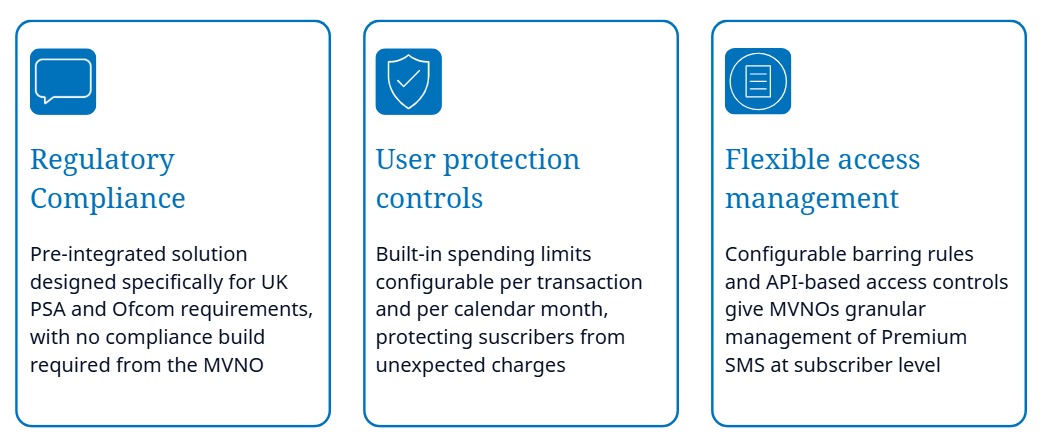
- Pre-integrated solution designed for UK regulatory compliance
- Built-in user protection mechanisms, including spending limits (per transaction and per month)
- Flexible access controls (barrings, API-based configuration)
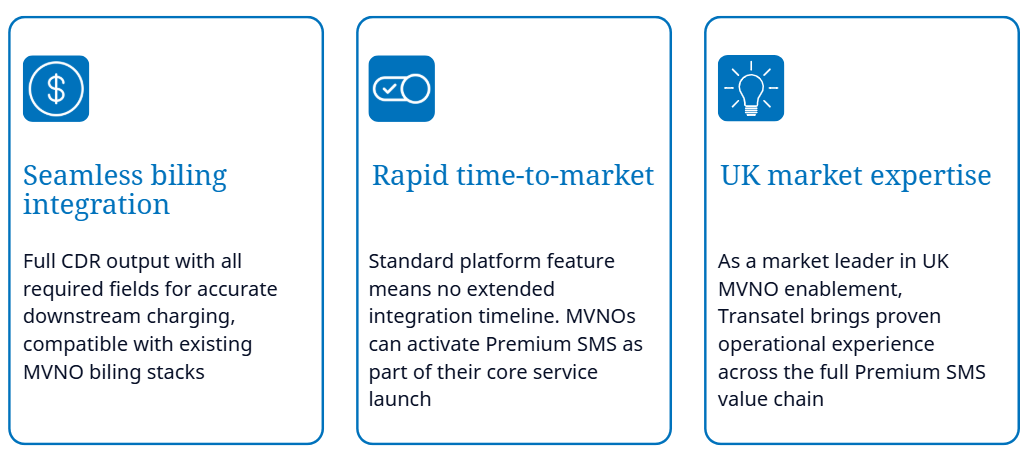
- Seamless billing integration, with the needed CDR information for accurate charging
This allows MVNOs to enable Premium SMS quickly, while maintaining full control over the customer experience and ensuring a secure and compliant environment.
To learn more about Premium SMS and our MVNO offerings in the UK market and beyond, get in touch with our team.
Yes, operators can configure barring options, apply spending limits, and manage access via APIs to tailor the experience.
Transatel offers a fully integrated, compliant solution with built-in controls, flexible configuration, and seamless billing support as part of its standard MVNO offering.
It provides a fast, accessible way to make payments or interact with services directly from their mobile device without extra steps.
Historically, it required complex integration with SMS routing, billing systems, regulatory compliance, and dispute handling processes.
Pre-integrated MVNO solutions like Transatel’s, now offer built-in compliance, simplified billing integration, and ready-to-use controls, reducing technical and operational barriers.